Advocacy #6: MAKE IT STOP!
The R word.
I mean, seriously.
It’s 2015.
Don’t say it. Don’t avoid calling others out on it when they say it.
There are people who will try to make you feel really bad about telling them to stop using the R word. They will tell you that you are too sensitive and they mean nothing by it and that people these days need to “lighten up.”
Be tough. Be strong. Be brave.
Keep fighting.
Advocacy #5: Use people-first language
In the Down syndrome community, great effort is made to help the world see our children first. There are pros and cons to having a visible disability. On the positive side, people recognize that you may need help. On the negative, people assume that you need help. It’s a double-edged sword.
People-first language establishes that an individual is defined as a person before any particular diagnosis. It means calling Tessa “a child with Down syndrome” and not a “Downs child.”
I have to assert here that we are talking about the Down syndrome community. Other communities (for example, the Autistic community) have a different viewpoint.
To me though, people-first language means dropping the label altogether as often as possible. I realize that there are times when her diagnosis needs to be communicated and referred to. I’m not in the business of pretending that it isn’t there. However, in my mind, person-first language goes beyond saying “a child with Down syndrome” and just saying “a child.” An example…. humor me here, please…
Say you run into Tessa and I in a Panera. She’s her usual ham of a self, giving you high-fives and blowing kisses.
“Wow!” you might respond, “what a sweet little Downs baby!”
or maybe “Wow! What a sweet little baby with Down syndrome!”
or perhaps “Wow, what a sweet little baby!”
In the Down syndrome community, our preference would be choice three.
But, shhhh, I’ll tell you a little secret. If you mean no harm, I’m not going to correct you on any of it.
I’ll be the first to recognize that for the standard human, there are a lot of rules to follow from a variety of communities who all just want what is best for their members. My plea tonight is not just to those who are not directly tied to the Ds community, but to our own members as well. Fight the battles worth fighting. Make a point to teach a lesson when you can make a difference. Use love and example and above all else, be patient with those who are learning.
If the person is being blatantly rude just to be an ass, by all means, have at them.
But otherwise, lead by example. People first, if you would please.
Advocacy #2: Donate
Can we just get this one out of the way? It’s uncomfortable for me, it’s probably uncomfortable for you, but it’s advocacy with minimal effort and on a Friday night after Homecoming Week, it’s what you get.
Here is a cute picture to distract you from the awkwardness of this post:

In all seriousness, I would urge you to carefully consider which charities you choose when sending in donations. Some groups spend a lot of money on staff and publications and little on the cause itself. Others promote ideas that do much more harm than good (Autism Speaks, I’m calling you out). We have our own favorite Down syndrome charities and groups (listed below) that support our own viewpoint and mission for Tessa. There are others, but these are the ones that we feel best support inclusion and advocacy for individuals with Down syndrome:
National Groups:
National Down Syndrome Society – http://www.ndss.org/About-NDSS/Mission-Vision/
National Down Syndrome Congress – http://www.ndsccenter.org/mission-and-history
The Down Syndrome Diagnosis Network – http://www.dsdiagnosisnetwork.org/
Local to Illinois/Chicagoland:
National Association for Down Syndrome: http://www.nads.org/about-us/
UPS for DownS: http://www.upsfordowns.org
One more for those who are into medical research and treatment (I’m still undecided):
The LuMind Foundation – http://www.lumindfoundation.org/
Happy Donating! 🙂
Advocacy #1: Be “In the Know”
Let’s be realistic here: the vast majority of people we meet in the street know little to nothing about Down syndrome. I knew as much as my ninth grade Biology teacher had taught me (I was a good student, but still, not much stuck). Extra chromosome, learning difficulties, yada yada.
I knew nothing.
While I know lots now, I still know nothing.
When I talk with other people, I have learned to assume they know nothing realistic about Down syndrome and take the approach that it is simply my job to teach them. After all, two years ago, I knew nothing. Why would they? In addition to that, people who were born with Down syndrome even 10 years ago have a dramatically different life experience than those being born today. It is important to educate ourselves if we, in turn, want to educate others. Believe me, there is nothing that I love more than setting the record straight when it comes to information about Down syndrome.
Some facts for you… so that you can be “in the know” when someone starts talking about Down syndrome:
Down syndrome (Trisomy 21) occurs when a third copy of the 21st chromosome is present in an individual.

There are three types of Trisomy 21 – translocation and mosacism are much more rare. Tessa has the standard type. Usually, the extra chromosome is from the mother, but in about 8% of cases, it comes from Dad.
No, we don’t know which parent gave Tessa her special gift.
Trisomy 21 is a random and common abnormality. It’s not a disease, it’s not contagious, it’s not preventable, it’s not predictable. It happens equally across all races, religions, and economic backgrounds. Yes, the odds increase as a woman ages, but most babies with Down syndrome are born to younger moms simply because younger moms have more babies in general.
You will often hear about the IQ of people with Down syndrome being low to very low. However, we know now that IQ tests do not accurately measure the intelligence of people with Down syndrome because of their difficulties with communication. We know that with interventions and schooling and inclusion, people with Down syndrome most often live independent lives. They can learn to drive cars, get married and some have children. They can work, they can go to college. They can do most anything – they just need some extra time and maybe some extra help.
Typical issues that people with Down syndrome might deal with include heart defects, intestinal issues and Celiac disease, hypothyroisim, obstructive sleep apnea, leukemia, and in the long term, Alzheimer’s disease. Not everyone will have these issues.
It is important to know that while these occur more often in Down syndrome than in the typical population, response to treatment is much more successful if a person has Ds.
Most importantly, studies continue to show that people who have Down syndrome tend to express very high levels of satisfaction with their lives. In one study, 99% of the over 3,000 individuals studied reported being happy with their lives and 97% like who they are. Their families are generally content; families also experience lower divorce rates than those without children with Down syndrome.
Please stop for a moment and think about all of the people that you know. Are 99% of them happy with their lives?
Food for thought.
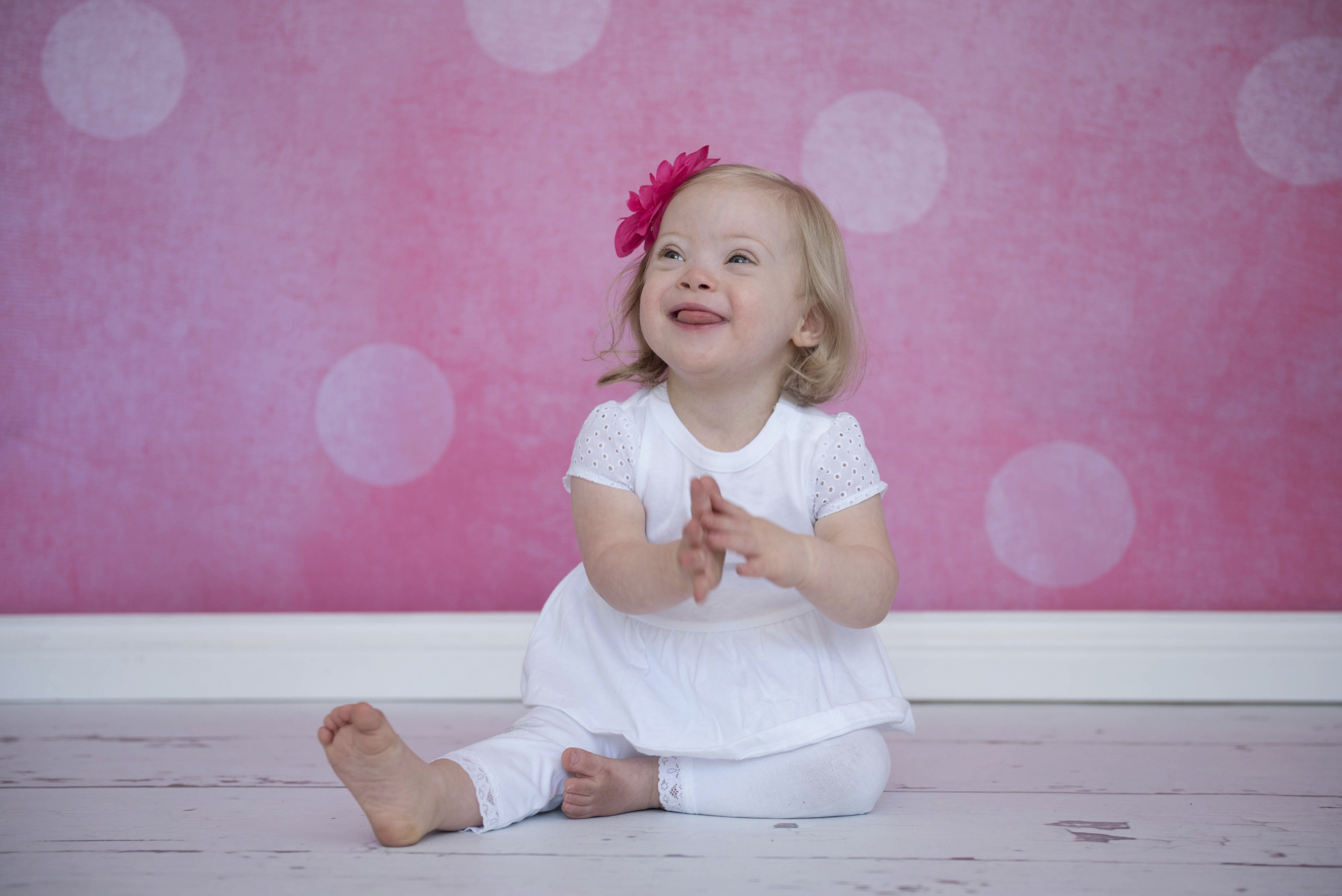
Get ready… get set…
Last Wednesday at 8:30 pm, well past my bedtime, I found myself sitting at the kitchen table, hastily drawing on posters and t-shirts for a rally to preserve Early Intervention funding in Illinois.
“Mag,” John quipped from across the room, “you were born to be an advocate. You just needed a cause.”
This is true.
Before I had Tessa, if asked what my hobbies were, I had no answer. I’m not boring (I don’t think), just never had something that totally captured my interest. Now, I have Down syndrome and special needs advocacy. It’s an odd thing to qualify as a hobby, I suppose. It’s not something that I do for fun necessarily. In a way though, it’s something that I do because it feels productive and important and that is fun in my mind.
I recognize, of course, that this brand of advocacy is not for everyone. Heaven knows that I’ve had enough conversations with enough people to know that some find us to be “takers, not makers” and unworthy of such silly requests as funding for basic therapies and a place in the classroom.
Ugh. We’ll be addressing this later.

In any case, all of this is important because tomorrow, October 1st, marks the beginning of Down Syndrome Awareness Month and the 31 for 21 Challenge. Last year, we wrote about 31 things that we have learned since we had Tessa. This year, we’re sharing 31 mostly simple ways that you can advocate for people with Down syndrome (or people with special needs in general). I would never presume to tell you that just because this is my cause that it has to be yours, too. But, if you should want to make a small difference in the lives of people like Tessa, in honor of this month or just because you want to, we are excited to share some ways to make a difference.
Thanks for joining us.
To hear our radio interview at the Early Intervention rally last week… click here: http://wuis.org/post/funding-worries-persist-parents-disabled-children
On abandonment
We’ve all seen the latest story that is trending on Facebook… you know the one, the story of the father who is (allegedly) choosing to raise his son, diagnosed with Down syndrome at birth, in spite of the mother’s choice to (allegedly) abandon the child. You can google the story if you haven’t seen it already. I honestly can’t decide if any of it is credible enough to merit a link. What I will say is this:
I will not demonize the mother for the choice that she seems to have made, nor will I canonize the father for taking his son to New Zealand in search of better opportunities.
While the choice to leave my child to be adopted in the face of her diagnosis is clearly not the choice that I would make, understand that I am part of a strong and loving marriage, we aren’t rich, but we are comfortable enough, and we have the support of family and friends. Sometimes, the most loving thing that a birth parent can do for her child is to recognize that she is not in a place to provide what is needed. And there are many loving families desperate to welcome a child into their homes.
More importantly, I beg you, do not be naive enough to think that these very scenarios do not play out in hospitals across the United States. Many doctors (thankfully, not mine) deliver diagnoses like these as if they are devastating, miserable, horrific occasions. It’s not just Down syndrome – any deviation from the neurotypical path is scary, but it does not have to be a death sentence. And while the gender of the ‘parent who stayed’ is often reversed, there are relationships that fall apart in the face of all kinds of adversity – including the strain of a child with special needs.
We will commend the father for providing for his son, but have we abandoned our own? Will we invite the little boy with Down syndrome in our son’s class to his birthday party? And then truly and genuinely allow ourselves to see him as just another 8-year-old boy? Will we set up a playdate with the neighbor’s daughter who has autism? Will we accept a child with a severe learning disability into our classrooms and do everything we can to support his desire to learn? Do we refuse to abandon the children who live in our own community? Without patronizing, without any air of superiority or feeling of having done a good deed… if you want to make a difference in this world, this is your chance.
Pray for the families that struggle under the strain of a world that has not yet found a way to embrace their child.
Encourage inclusion, acceptance, kindness, and compassion.
Let your actions serve as example to others.
Choose love.
Lesson #28: I wish it wasn’t on the news (sort of).
This is part of the 31 for 21 Blog Challenge! We’re almost to the end……
Frequently, news articles pop up on my Newsfeed on Facebook with headlines like Couple with Down Syndrome Chosen as Prom King and Queen or Man with Down Syndrome Opens Restaurant. I love these celebrations of people’s accomplishments. They are “feel good” stories. They are inspirational, barrier breaking, door-opening.
They also make me sad.
Articles like the above represent a weird paradox for me. I am uplifted by them because they are a reminder that there are no limits to what Tessa can do. I’m annoyed by them because if society would just stop seeing her as less than, they wouldn’t have to be news stories in the first place.
Celebration and a heavy sigh in the same breath.
I want Tessa to be accepted by her peers and I don’t want someone on the Nightly News to think that acceptance merits a news story.
I want Tessa to do whatever she is capable of and I don’t want anyone to be surprised when she does.
I realize that we are not there yet and so the new stories are necessary. I’m thankful that the message being spread is that people with Down syndrome can (whatever). I know that when we first got the diagnosis, there was a tremendous amount of comfort for my husband in watching a YouTube video of a boy with Down syndrome receiving a college acceptance letter. He probably watched it 400 times during the first week After. I just hope that someday, this becomes so commonplace that we can celebrate in the same way we would for our typical daughter – with a dinner out at Chili’s and an extra scoop of ice cream for dessert.
Someday.

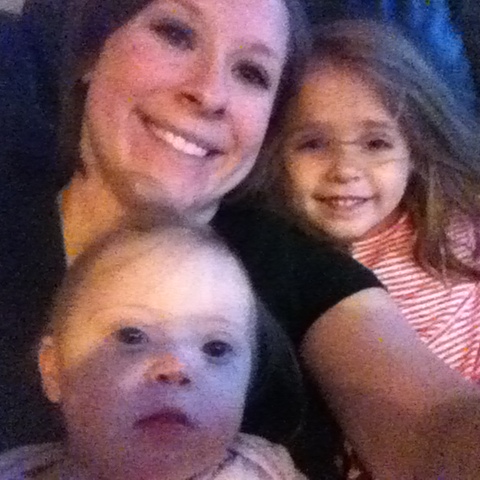
And now, a little group selfie (are these called “groupies” yet?) fun…



Lesson #21: Unintentional Ableism
Ableism – a set of practices and beliefs that assign inferior value (worth) to people who have developmental, emotional, physical or psychiatric disabilities.
We would love to see Tessa break down barriers, exceed expectations, go beyond anyone’s wildest predictions of what she will accomplish in her lifetime. John and I have no preconceived notions for what she will do with her life. Full inclusion through high school? Why not? Go to college? OK! Open a restaurant like Tim’s Place? Dandy! Star in a TV show like Glee? Great! We set no limits on her potential and watch to see what happens. Hopefully, that is a powerful force in her life that pushes her to do her best.
She might not do any of those things.
The reality of our future with Tessa (and with any child, really) is that we have no way to predict what will come as she grows. It is certainly our responsibility, as parents, to teach our children to live to their full potential. However, we cannot pass judgement on what that potential is.
There is still value in the life of an adult who bags groceries at the local supermarket.
There is still value in the life of an adult who lives with his parents and takes public transportation to a minimum-wage job.
There is still value in the life of an adult who “makes your french fries.”
(On a side note, I just need to vent for one second about the statement “well, someone has to make my fries.” There is nothing wrong with making french fries. And yes, someone really does have to make them for you unless you plan on climbing into the drive-thru window at McDonald’s and making them yourself. So why do we need to use this as a sarcastic comment to mock a person’s intellectual ability? Just wondering.)
Being successful has nothing to do with money. It has nothing to do with power. It has nothing to do with influence or intelligence or ability or stuff. It has everything to do with abounding love, kindness to the most unkind people, friendship, compassion, and contributing in the best way that one can.
I get that now.

This is part of the 31 for 21 Blog Challenge!
Lesson #18: Little babies can do Speech therapy!
This is part of the 31 for 21 Blog Challenge!
So, first of all, this happened:
 Ellie was enthralled with her potty costume… Once her cousin Jimmy came over dressed as Curious George, it was over. Somehow, Ellie convinced him to shed his costume so that she could wear it and then the two of them had a grand ol’ time pretending to use the potty. Kids are weird.
A rough transition here…. on to Speech.
It was very perplexing to me that we could start Speech therapy on a 6-week-old baby. However, with Tessa unable to take her bottle in an upright position, we were set up with a type of Speech therapist who specializes in Oral-Motor therapy. Oral-Motor therapy teaches a child awareness, coordination, and strength of the muscles of the mouth (all related to that low muscle tone that we keep talking about).
(On a side note, because I know some are curious, no, my children have not really been nursed. Ellie got 5 days and Tessa got 12. That’s a whole other story.)
During a therapy session, we work a lot on building strength in her core muscles. When you think about eating, you use muscles throughout your abdomen, neck, and head to eat effectively. One of the ways that we can improve Tessa’s eating skills is to build strength throughout her body so that she will be stable when she is sitting and can begin to use her hands to move food to her mouth. This part of the session focuses on sitting and bringing toys to the mouth.
We also work on direct input to the mouth itself. We started by providing input with a tool like this:

We use it to teach her tongue and gums what different textures and pressures feel like. We also work on stimulating her tongue to move around the mouth to react to food. Lately, we have graduated to putting small crumbs of graham cracker or animal cracker on the sides of her mouth so that she learns to move the food and to swallow it.
We always end our session with feeding. Well, I shouldn’t say always. Sometimes, Tessa gets really mad when she doesn’t get fed first. And sometimes, she decides that she has had enough and just closes her eyes and goes to sleep. However, we like to do some “spoon work” with the therapist when Tessa will let us. 🙂 We have found that a forward-facing presentation of the spoon (how you or I would put a spoon in our mouth) is challenging for her, so we present the spoon sideways. However, we also continue to work on the forward presentation. We are teaching her to get the food off the spoon and swallow. She also has a habit of sticking her tongue out while she eats, so we have to wait until she puts her tongue in the right place before allowing her to take a bite. Remember that a tongue is made up of a lot of different muscles, so her low muscle tone affects her ability to keep it in the appropriate place and use it effectively.
Our next steps with Tessa are to introduce a straw cup (recommended over a sippy cup) and to slowly increase the variety of textures that she will tolerate. We have begun to work on the actual “speech” part of Speech therapy with practice mimicking noises, We have introduced signs for more, all done, eat, and drink.
The most important thing to remember is that while we have made modifications for Tessa and we do have to make a conscious effort to teach her some skills that may come naturally to others, our life is not work. We don’t live in a constant therapy session, always practicing, practicing, practicing. When we can, we do these things. That is all. There are weeks when we do a lot of practice. Sometimes, we don’t. Eventually, we’ll get there.
An excellent resource that I have just started to dive into is Early Communication Skills for Children with Down Syndrome. Click on the blue link to find it on Amazon.
Blurry, but perfect…


 Yo soy La Lay