This really IS me taking the easy way out tonight. We’re a little swamped with baseball around these parts. Instead of my usual ramblings, enjoy this nice video from Kid President:
This really IS me taking the easy way out tonight. We’re a little swamped with baseball around these parts. Instead of my usual ramblings, enjoy this nice video from Kid President:
If we can accept that 1) behavior is communication and 2) people who have special needs don’t need to be shuttled off to their own separate events in their own separate places, then we probably need to address the ways that we can help make reasonable accommodations to the environment so that all can be included.
A lot of people who have special needs have trouble with communication. Maybe their ears don’t hear in a typical way, or their mouth has some difficulty with the words, or they need some extra time to process what is being said or expressed… there are a lot of reasons that a person may need extra support with communication.
In our world, we have relied heavily on sign language to communicate with Tessa. Back when she was quite young, I struggled with whether or not to introduce sign. As a language teacher, I know the value of input and I thought that inputting both words and signs would keep her from learning to speak.
I was wrong.
There is a decent amount of research that shows that using sign can actually enhance the ability of all children to express themselves and learn to use speech (see an overview of the research with citations from Signing Time here). For us, it has been very powerful. Tessa does have a few words (no, moo, down, definitely some others) and coincidentally, most of the words that she says are not the ones that she signs. She also has a lot of feelings. Her signs help her communicate those feelings and mean less frustration for both of us!!! Her use of sign is strong; she has about 15-20 consistent signs that she can use in a variety of ways (mostly to ask for “more cookies please”).
Everyone in the world does not need to go out and learn a bunch of sign. It probably wouldn’t hurt if you wanted to pick up a sign or two… maybe more if you are going to need to communicate with Tessa on a regular basis. More importantly, you can advocate for the needs of others by accepting that people will communicate in a different way than you do and by practicing patience as they process and work to express themselves.
I cannot stress this enough – the more we can support and normalize some of the needs that people have, the less marginalized they might feel. The less marginalized people feel, the better we are as a society.

You probably think I’m cheating a little bit at my 31 for 21 Challenge when I post videos, but there is a lot to be learned from the voices and experiences of others. You might not seek out these types of videos like I do. I hope you watch them, most especially the one below.
It is 17 minutes long. I know, it’s extensive. I promise, it’s worth every second. Because getting the message of this video means “getting” my family’s perspective. This is what we are about. This is what we are advocating for.
Is it is the same as every other family? No, most definitely not. But at home, in school, and in life, this is the cornerstone about our approach to Down syndrome. I hope you will take some time out to understand us.
You cannot advocate for the real needs of a person with a disability until you are willing to accept and understand that in all humans, behavior is communication.
Behavior IS communication.
This is so important, most especially in a world where people have more limited ability to express their thoughts and needs or those who need extra time to process what is going on.
I spoke with a group of high school students this week about Down syndrome and what it means for our family and Tessa. We spent quite some time talking about how low muscle tone affects her ability to function and how it has caused some challenges in speech. We talked what it might be like to live in a world where we could not communicate our needs.
If you remember back to Spanish class in high school, your teacher probably forced you to ask in Spanish if you had to go to the bathroom. Speaking with the students, I asked them to recall a time when they (or another student) really, really had to go, but couldn’t remember how to ask. We talked about what that looks like. The kids giggled quite a bit, thinking about the dancing and the frantic pacing and the mad dash to look up the words in the Spanish dictionary… and then we talked about what it might feel like to be that way all the time, how if you were in the grocery store and a clerk was rapid-fire asking questions (paper or plastic? debit or credit? coupons? milk in a bag?), it might be overwhelming and over time, you might develop some other coping strategies to say “slow down, I need time to think!”
When you see a behavior that doesn’t fit into the standard view of what would be “normal,” understand that the behavior is communicating some feeling or need. Patience is advocacy. Acceptance is advocacy. Love is advocacy.
Happy Saturday!

There has recently been a lot of hoopla in my world about the “right” way to celebrate Down Syndrome Awareness month. Do we call attention to the disability? Do we ignore it and just show our families living “normal” lives? Do we point out the differences in our children? Do we show how they are doing all the things that typical children are doing? Do we do nothing?
All are good and valid.
I do not believe that society has moved far enough toward acceptance of individuals with intellectual and physical disabilities to ignore Down syndrome awareness efforts. I do not believe that my child should be singled out because of her disability. I do not believe that we should shy away from any opportunity that would “normalize” the life that we lead. I do not believe that our life is normal. Whose life is normal?
I like to wear the colors – I like to have fun with awareness and buy goofy t-shirts and give people a reason to ask questions, So I like things like these little gems. And if you like them too, you can find them and buy them and wear them. Links to their respective “stores” are included:
From The Littlest Warrior, cute shirts like this for the kiddos…

And adults…

For jewelry, I love Etsy. Search “down syndrome” and you’ll find lots of cool stuff like these:
(I have this first one and LOVE it)
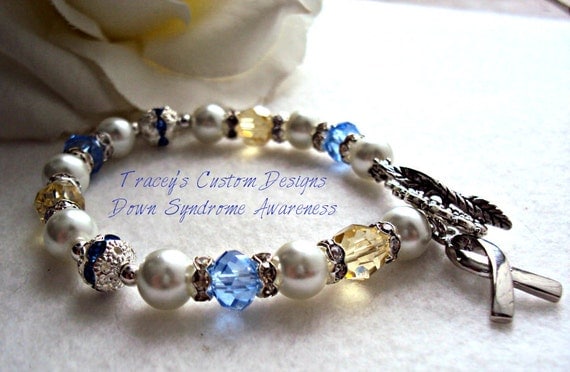
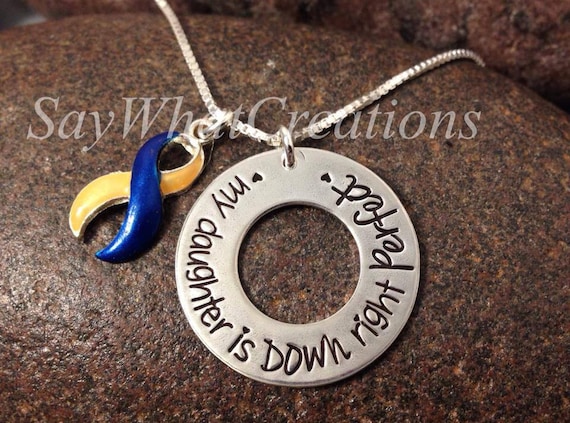
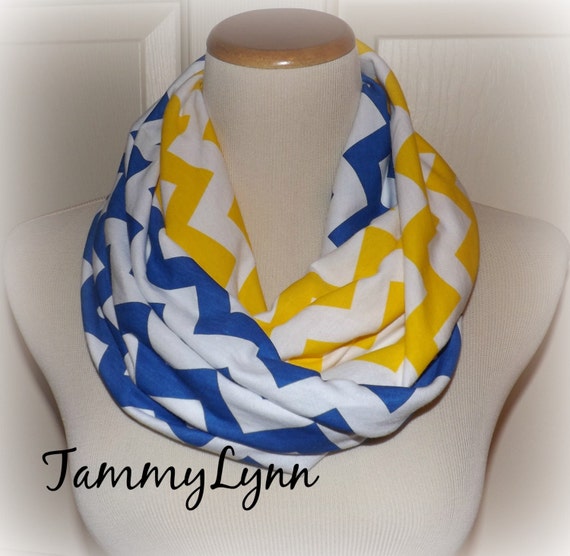
You can also shop the stores of some really great groups, like the shop through the NDSS.
Advocacy through fashion… I like it! 🙂
The R word.
I mean, seriously.
It’s 2015.
Don’t say it. Don’t avoid calling others out on it when they say it.
There are people who will try to make you feel really bad about telling them to stop using the R word. They will tell you that you are too sensitive and they mean nothing by it and that people these days need to “lighten up.”
Be tough. Be strong. Be brave.
Keep fighting.
In the Down syndrome community, great effort is made to help the world see our children first. There are pros and cons to having a visible disability. On the positive side, people recognize that you may need help. On the negative, people assume that you need help. It’s a double-edged sword.
People-first language establishes that an individual is defined as a person before any particular diagnosis. It means calling Tessa “a child with Down syndrome” and not a “Downs child.”
I have to assert here that we are talking about the Down syndrome community. Other communities (for example, the Autistic community) have a different viewpoint.
To me though, people-first language means dropping the label altogether as often as possible. I realize that there are times when her diagnosis needs to be communicated and referred to. I’m not in the business of pretending that it isn’t there. However, in my mind, person-first language goes beyond saying “a child with Down syndrome” and just saying “a child.” An example…. humor me here, please…
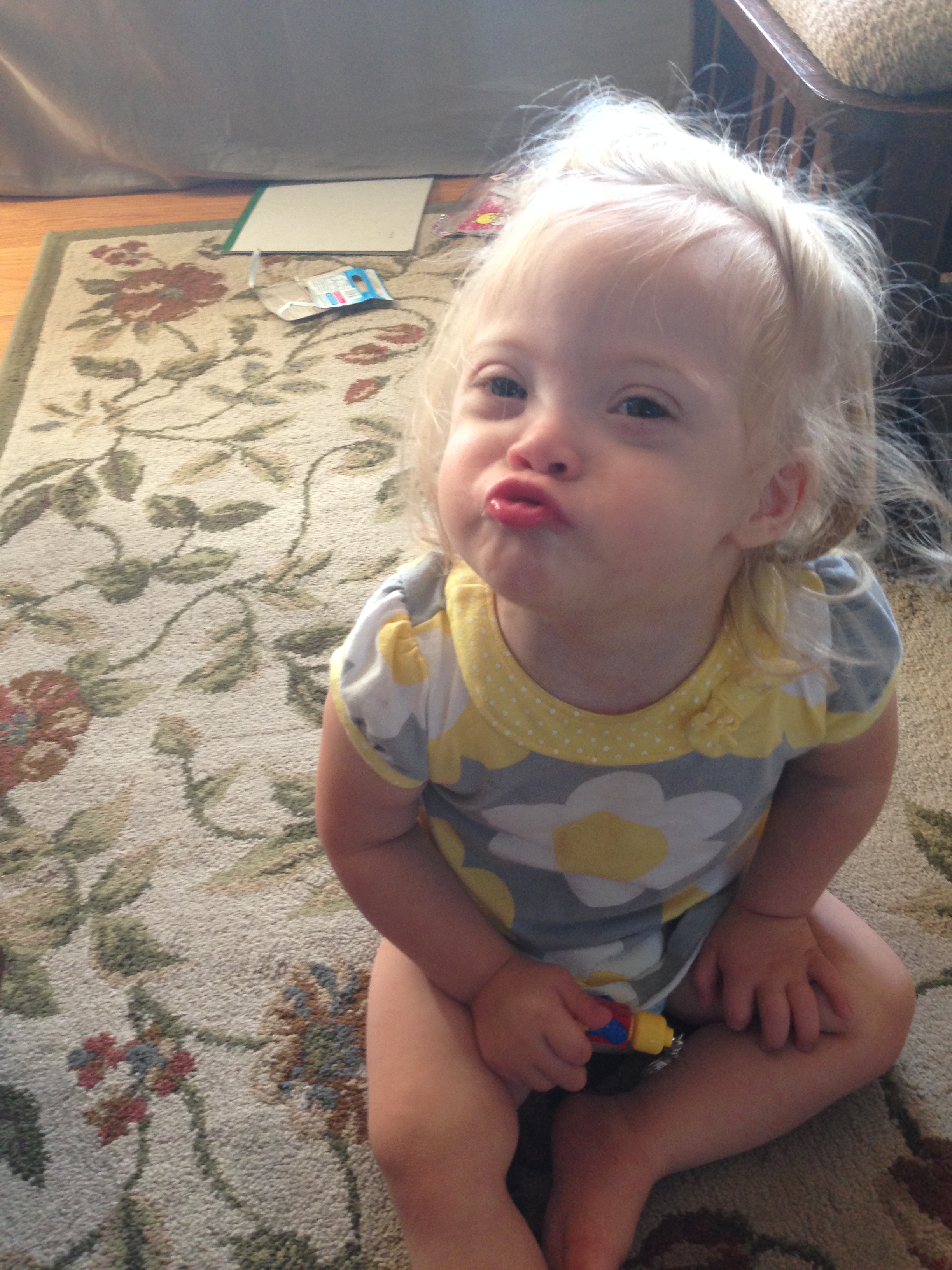
Say you run into Tessa and I in a Panera. She’s her usual ham of a self, giving you high-fives and blowing kisses.
“Wow!” you might respond, “what a sweet little Downs baby!”
or maybe “Wow! What a sweet little baby with Down syndrome!”
or perhaps “Wow, what a sweet little baby!”
In the Down syndrome community, our preference would be choice three.
But, shhhh, I’ll tell you a little secret. If you mean no harm, I’m not going to correct you on any of it.
I’ll be the first to recognize that for the standard human, there are a lot of rules to follow from a variety of communities who all just want what is best for their members. My plea tonight is not just to those who are not directly tied to the Ds community, but to our own members as well. Fight the battles worth fighting. Make a point to teach a lesson when you can make a difference. Use love and example and above all else, be patient with those who are learning.
If the person is being blatantly rude just to be an ass, by all means, have at them.
But otherwise, lead by example. People first, if you would please.
We interrupt this regularly scheduled program to share an exciting morning. Our thoughts on advocacy will continue tomorrow, but I thought it was important to share that Tessa and I had our first conversation this morning.
At an unreasonable hour (5:56 am), Tessa was being quite loud in her crib, so we took her out and made her crawl around in bed with Mom and Dad. After about half an hour, she got a little restless.
(All words were signed and spoken by me. Tessa spoke “down” but just signed the rest.)
Tessa: Da… Da… Da! (down)
Me: Oh, you want to get down from the bed?
Tessa: Da. (points forcefully at the door)
Me: Downstairs?? No, wait.
Tessa: Da. Eat. Milk.
Me: No, wait. No milk, no eat. Wait.
Tessa: Cookie.
Me: Wait. No cookie. Wait.
(pause)
Tessa: Cookie please.
BOOM. Tessa for the win.


 Yo soy La Lay