Yo soy La Lay

adventures in family, faith, and Down syndrome

Advocacy #21: Inclusion Part 1

The first in a series on inclusion and what that means to us….

Because everyone can add to the richness of community.

Because everyone has value.

Because no one likes to be excluded.

Because no one likes to be told they can’t.

Because it’s good for everyone.

EVERYONE.

Because there is always a way.

Leave a comment »

Advocacy #19: Give the siblings a little credit!

It is a little disheartening when people worry (quite intensely) about Ellie’s role in her sister’s life.

My sister does not have any kind of disability.  In reality, someday, she could end up with one.  We all could.  One accident, one illness, one life event that doesn’t go as planned and we may find ourselves needing help.

I would walk my sister to the ends of the earth if she needed it.

In a 2011 study (abstract linked here), 94 percent of siblings age 9 and older expressed feelings of pride about their sibling. 88 percent said they felt they were better people because of their sibling with Down syndrome. Only 4 percent said they would “trade their sibling in” for another.

In our home, Ellie finds plenty of ways to shine, but she also adores her little sister.  I’m not naive enough to think that every day will be fabulous and that there won’t be times when Ellie resents the attention or the treatment that Tessa gets… but believe me, those same feelings will come from Tessa about Ellie as well… as they do in any family situation.

What I am saying is that it is helpful if you just treat them as what they are – siblings.  Not as one being dependent on the other, not as if one may be a burden, but as two sisters who lean on each other for support from time to time.  Often times, advocacy is in the simple act of just letting us be typical.  We are just typical.

These two… typical.

IMG_9539

(Yes, that is a pen drawing on Tessa’s forehead.  Ellie thought she needed a tattoo.)

Leave a comment »

Advocacy #18: Encourage doctors to get it right

Did you know that several states are working to pass laws right now that would require doctors to give current, unbiased information to parents who are given a Down syndrome diagnosis for their child?

If you think like I do, you might wonder why we need such a law.  It seems odd, doesn’t it?  Why wouldn’t a doctor provide parents with accurate and up-to-date information about this diagnosis?  Why wouldn’t you expect that doctor to know what he is talking about and trust that he is giving you the most current data?

Well, sometimes they don’t.  Actually, many times, they don’t.  Page through the book Unexpected and you will hear lots of stories about medical professionals who got it wrong.  I believe that ours got it right.  And I believe that part of why they were able to communicate so well with us is because we have some groups that really work hard to educate medical professionals on what life is like now with a child who has Down syndrome.

The National Association for Down Syndrome (NADS) is one of our local groups and is actually the group started back in 1961 when a group of parents in the Chicago area decided to raise their babies at home rather than sending them into institutions.  Among a lot of other programming, they send groups of parents and advocates into area hospitals to meet with medical professionals and help them learn about our lives.  They encourage physicians to ask questions and open the line of communication so that others can move past their initial fears. 

On a national scale (and even international), the Down Syndrome Diagnosis Network is also working hard to provide current, relevant information to medical professionals so that they can work with families.  They offer a variety of print materials for doctors and nurses to read for heir own knowledge, as well as items to share with families.

Both of these organizations are well worth your time to check out.  We are so thankful that we and others can access this information!!!

Leave a comment »

Advocacy #17: Let me act my age.

A letter from Tessa to everyone:

Dear everyone,

My mom says to tell you that she promises not to make a habit of talking for me.  She keeps telling me that I will have to “advocate” someday too and that she will speak up for me until I do it on my own and then she will speak with me, not for me.

But I want to tell you something!  Did you know that soon, I will be two?!  Can you believe it??  My birthday is coming in a couple short months, and even though I don’t walk yet or talk yet, I’m a toddler!

I know it’s hard to remember because sometimes I do things that babies do… And I’m little, so I look kinda like a baby.  But ya know what?  I really like it when you treat me like I’m my age.  

I hear that lots of people like me feel the same way!  It can be hard when people treat others with Down syndrome like they are kids, even when they are not.  Once my mom told me that she hopes people will always “presume competence” and make accommodations for areas that challenge me, but not “lower the bar” or treat me like I don’t know what it means to be an adult.  I don’t really get what she means by all that mumbo jumbo.  All I know is that I want people to believe that I’m not a baby.  I just want to be one of the kids! 
You can advocate for me by showing the world that I am my age.  If you always treat me like a baby, it might be harder for me to grow!  Plus, I get a little bummed out when other kids my age get to do fun stuff and people think I can’t be a part of it.  Let me play with kids my age – let me have the same privileges and experiences that they do (especially if it involves treats).  I will raise to whatever bar you set for me, so make it high. 

Love you!

Tessa


Leave a comment »

Advocacy #14: Accept truths, not outdated information

Holy cow, there is a lot of bad information out there.  And one of the greatest challenges that we face is combating that bad information with updated, current, research-based knowledge about life with Down syndrome.

Because of advocacy and groups of people willing to understand individuals with Down syndrome, there has been immeasurable progress in education and therapies to help live with some of the physical and mental challenges that they face because of their extra chromosome.  The world for a person with Ds today is nothing like it was even 30 years ago.

We do not expect that Tessa will live at home with us…. unless she wants to.

(After all, I do live with my parents these days, in case you forgot.)

We do not believe that she is any less likely to graduate from high school than Ellie is.  We know that if she wants to, she has post-secondary options, including college.

We do not expect that she will be forced into a job that she doesn’t like just because it’s the only thing available for someone “like her.”   We are here to help her follow her dreams, whatever they may be.

When you hear someone speak a non-truth about Down syndrome, one way to be an advocate is to correct their misunderstanding.  We believe in expecting that people know nothing and that we are here to teach them.  It’s a pretty constant inner struggle for me, but I have found that I get much better reactions with positive correction than being hostile… and I certainly feel much better than when I don’t correct someone.

Examples:

Them:  Hey, Maggie, I’m so sorry about this diagnosis.  Aren’t you guys worried that she’ll always live with you?

Me: Well, actually, research has shown that life in group homes or even independent living is very possible with Down syndrome.  We fully expect that Tessa will be able to live on her own.  Group homes are also less expensive than putting people in institutions, so we know that that is for sure out )plus institutions are just bad news bears).  And really, even if she lives with us, she’s kinda fun and she’s my kid, so I’m really good with whatever.

OR

Them: Wow, well you know, at least she’s pretty high-functioning!

Me: Well, actually, how she functions doesn’t have anything to do with Down syndrome.  People with Down syndrome either have it or they don’t.  “Mild” doesn’t exist.  However, they experience the whole range of abilities just like the typical population.  And even if she were to struggle more than others, we’d make it work.  She’s just a little human and we adore her.

OR

Them: I once saw this guy on the news that was helping some other guy with Down syndrome eat a meal in a restaurant. Isn’t that awesome?  Faith in humanity restored!

Me: Well, actually, it’s kind of awkward for me to talk about because I’m not really sure how that person with Ds feels about being the subject of someone’s pity that is now being broadcast all over the world.  I think it’s really great when people are kind to one another, I just think we do a lot of good when we take the dignity of each other into consideration before we take pictures of it and throw it out there for the world to see.

Speak the truth always.

Leave a comment »

Advocacy #11: LISTEN!!!

You probably think I’m cheating a little bit at my 31 for 21 Challenge when I post videos, but there is a lot to be learned from the voices and experiences of others. You might not seek out these types of videos like I do.  I hope you watch them, most especially the one below.

It is 17 minutes long.  I know, it’s extensive.  I promise, it’s worth every second.  Because getting the message of this video means “getting” my family’s perspective.  This is what we are about.  This is what we are advocating for.

Is it is the same as every other family?  No, most definitely not.  But at home, in school, and in life, this is the cornerstone about our approach to Down syndrome.  I hope you will take some time out to understand us.

1 Comment »

Advocacy #10: Accept that Behavior = Communication

You cannot advocate for the real needs of a person with a disability until you are willing to accept and understand that in all humans, behavior is communication.

Behavior IS communication.

This is so important, most especially in a world where people have more limited ability to express their thoughts and needs or those who need extra time to process what is going on.

I spoke with a group of high school students this week about Down syndrome and what it means for our family and Tessa.  We spent quite some time talking about how low muscle tone affects her ability to function and how it has caused some challenges in speech.  We talked what it might be like to live in a world where we could not communicate our needs.

If you remember back to Spanish class in high school, your teacher probably forced you to ask in Spanish if you had to go to the bathroom.  Speaking with the students, I asked them to recall a time when they (or another student) really, really had to go, but couldn’t remember how to ask.  We talked about what that looks like.  The kids giggled quite a bit, thinking about the dancing and the frantic pacing and the mad dash to look up the words in the Spanish dictionary… and then we talked about what it might feel like to be that way all the time, how if you were in the grocery store and a clerk was rapid-fire asking questions (paper or plastic?  debit or credit?  coupons? milk in a bag?), it might be overwhelming and over time, you might develop some other coping strategies to say “slow down, I need time to think!”

When you see a behavior that doesn’t fit into the standard view of what would be “normal,” understand that the behavior is communicating some feeling or need.  Patience is advocacy.  Acceptance is advocacy.  Love is advocacy.

Happy Saturday!

FullSizeRender (14)

7 Comments »

Advocacy #6: MAKE IT STOP!

The R word.

I mean, seriously.

It’s 2015.

Don’t say it.  Don’t avoid calling others out on it when they say it.

There are people who will try to make you feel really bad about telling them to stop using the R word.  They will tell you that you are too sensitive and they mean nothing by it and that people these days need to “lighten up.”

Be tough. Be strong.  Be brave.

Keep fighting.

2 Comments »

Advocacy #5: Use people-first language

In the Down syndrome community, great effort is made to help the world see our children first.  There are pros and cons to having a visible disability.  On the positive side, people recognize that you may need help.  On the negative, people assume that you need help.  It’s a double-edged sword.

People-first language establishes that an individual is defined as a person before any particular diagnosis.  It means calling Tessa “a child with Down syndrome” and not a “Downs child.”

I have to assert here that we are talking about the Down syndrome community.  Other communities (for example, the Autistic community) have a different viewpoint.

To me though, people-first language means dropping the label altogether as often as possible.  I realize that there are times when her diagnosis needs to be communicated and referred to.  I’m not in the business of pretending that it isn’t there.  However, in my mind, person-first language goes beyond saying “a child with Down syndrome” and just saying “a child.”  An example…. humor me here, please…

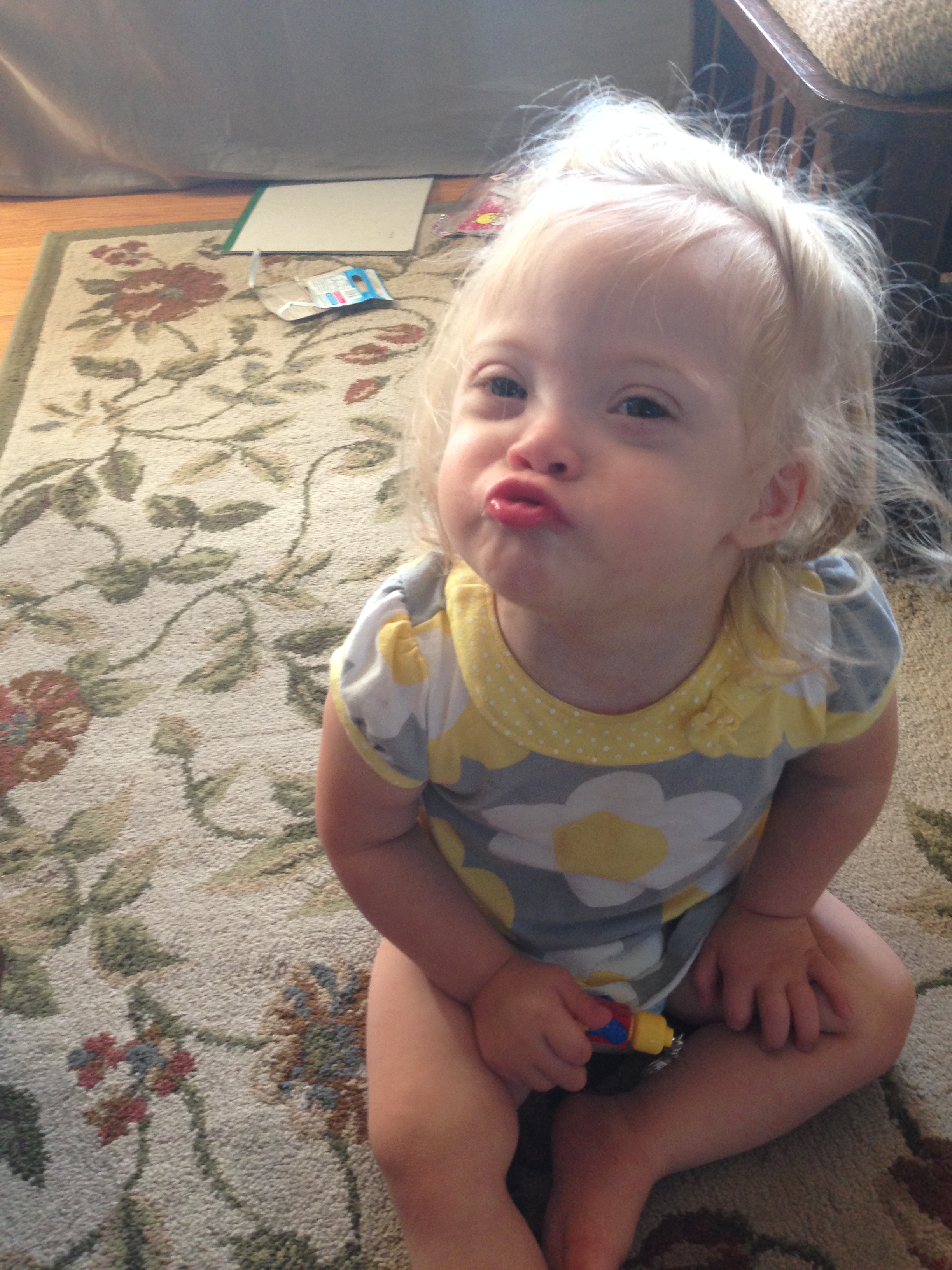
Say you run into Tessa and I in a Panera.  She’s her usual ham of a self, giving you high-fives and blowing kisses.

“Wow!” you might respond, “what a sweet little Downs baby!”

or maybe “Wow!  What a sweet little baby with Down syndrome!”

or perhaps “Wow, what a sweet little baby!”

In the Down syndrome community, our preference would be choice three.

But, shhhh, I’ll tell you a little secret.  If you mean no harm, I’m not going to correct you on any of it.

I’ll be the first to recognize that for the standard human, there are a lot of rules to follow from a variety of communities who all just want what is best for their members.  My plea tonight is not just to those who are not directly tied to the Ds community, but to our own members as well.  Fight the battles worth fighting.  Make a point to teach a lesson when you can make a difference. Use love and example and above all else, be patient with those who are learning.

If the person is being blatantly rude just to be an ass, by all means, have at them.

But otherwise, lead by example.  People first, if you would please.

1 Comment »

31 for 21 Day 4: A little off the topic of advocacy

We interrupt this regularly scheduled program to share an exciting morning.  Our thoughts on advocacy will continue tomorrow, but I thought it was important to share that Tessa and I had our first conversation this morning.

At an unreasonable hour (5:56 am), Tessa was being quite loud in her crib, so we took her out and made her crawl around in bed with Mom and Dad.  After about half an hour, she got a little restless.

(All words were signed and spoken by me.  Tessa spoke “down” but just signed the rest.)

Tessa:  Da… Da… Da!  (down)

Me: Oh, you want to get down from the bed?

Tessa: Da. (points forcefully at the door)

Me:  Downstairs??  No, wait.

Tessa: Da. Eat. Milk.

Me: No, wait. No milk, no eat.  Wait.

Tessa: Cookie.

Me: Wait.  No cookie.  Wait.

(pause)

Tessa: Cookie please.

BOOM.  Tessa for the win.

IMG_9260

5 Comments »