
This is part of the 31 for 21 blog challenge!
As is well documented on this blog (for example, here, here, and here), I often struggle with when Tessa will learn new skills. Lots of moms whose kiddos have special needs ask those questions. Impatience is just part of the game sometimes. When a baby is born with Down syndrome, the milestone charts get thrown out the window. We all know our kids will get where they are going; it’s just a matter of when. Waiting for when can be frustrating. The feeling that she should be able to do something nags a little at the back of my brain. From time to time, I freak out that I’m not working with her enough. And yet….
In the ebb and flow of my feelings about Down syndrome, I often find it immensely liberating that Tessa works at her own pace to meet her milestones. Milestone charts exist for a reason (above and beyond the ability for moms to compare their children 😉 ). They don’t really apply to Tessa because she has a diagnosed disability and we have known, since birth, that she’s on her own schedule. She has no should. However, the knowledge of when things should happen is actually vital to the typical child. When typical babies are born, milestone charts assist parents and doctors in determining if a child needs extra support or may have special needs. Unlike with Down syndrome, you cannot see a learning disability, autism, or a sensory disorder by looking at a child. Milestone charts, or knowledge of typical behaviors and development, help diagnose and support parents. They ensure that the child can receive interventions at the earliest possible time. We already have our diagnosis, and while a diagnosis certainly doesn’t make life any easier, the blessing of knowing what the diagnosis is is not lost on me.
For both Ellie and Tessa, at the beginning of each Well-Baby check-up, the nurse asks a series of questions about their development. When I have to answer about Ellie, I feel pressure. If she cannot do something, I go home and google when she should have mastered it. When they ask about Tessa, I just laugh. Many times, I get to say “yes, she can.” Sometimes, it’s a “not yet” or “we’re working on it.” But there’s no pressure. I have no need to compare what she can do to anyone else, because there is no should. And that is empowering.

This post was inspired by some moms in my Rockin’ Moms group on Facebook, organized by the Down Syndrome Diagnosis Network. Thanks, ladies, for asking great questions and being so supportive. 🙂
Amanda is the Nurse Practitioner that delivered the preliminary diagnosis of Down syndrome to John and I. For a long time, I really struggled with her decision on how to tell us about Tessa. But in celebration of Down Syndrome Awareness month, we’re sending her a letter of thanks. Here’s the letter:
October 3, 2014
Dear Amanda,
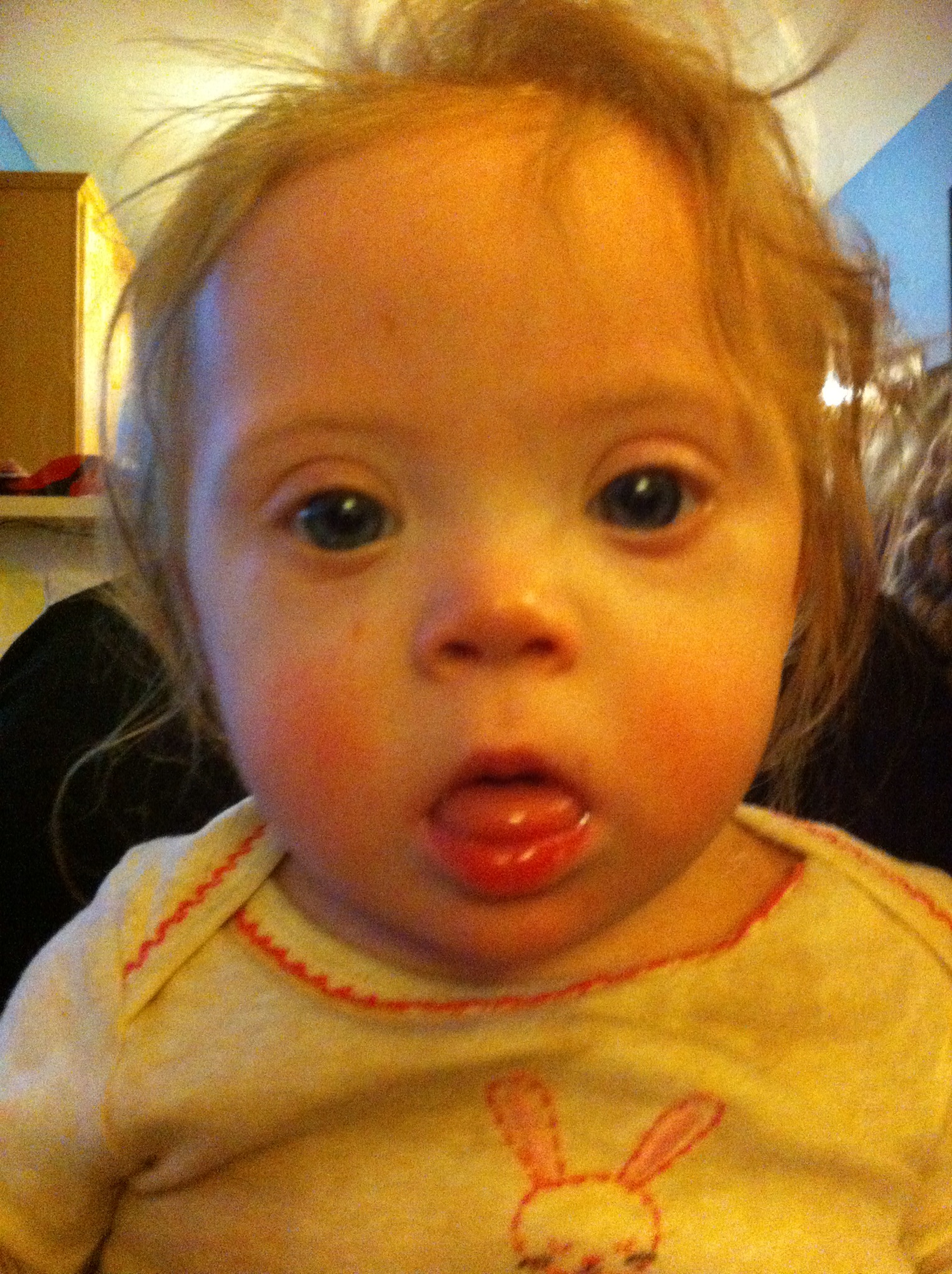
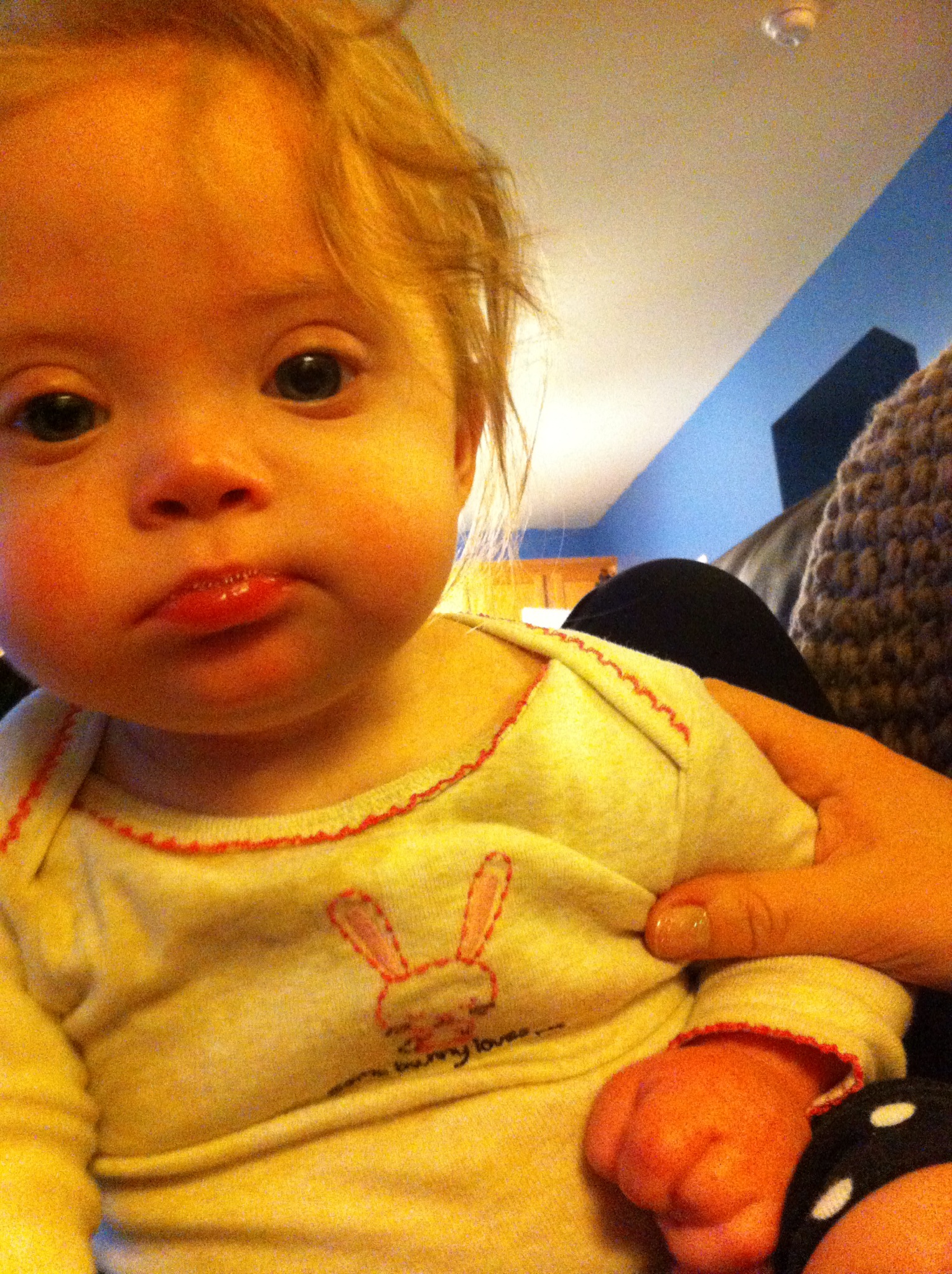
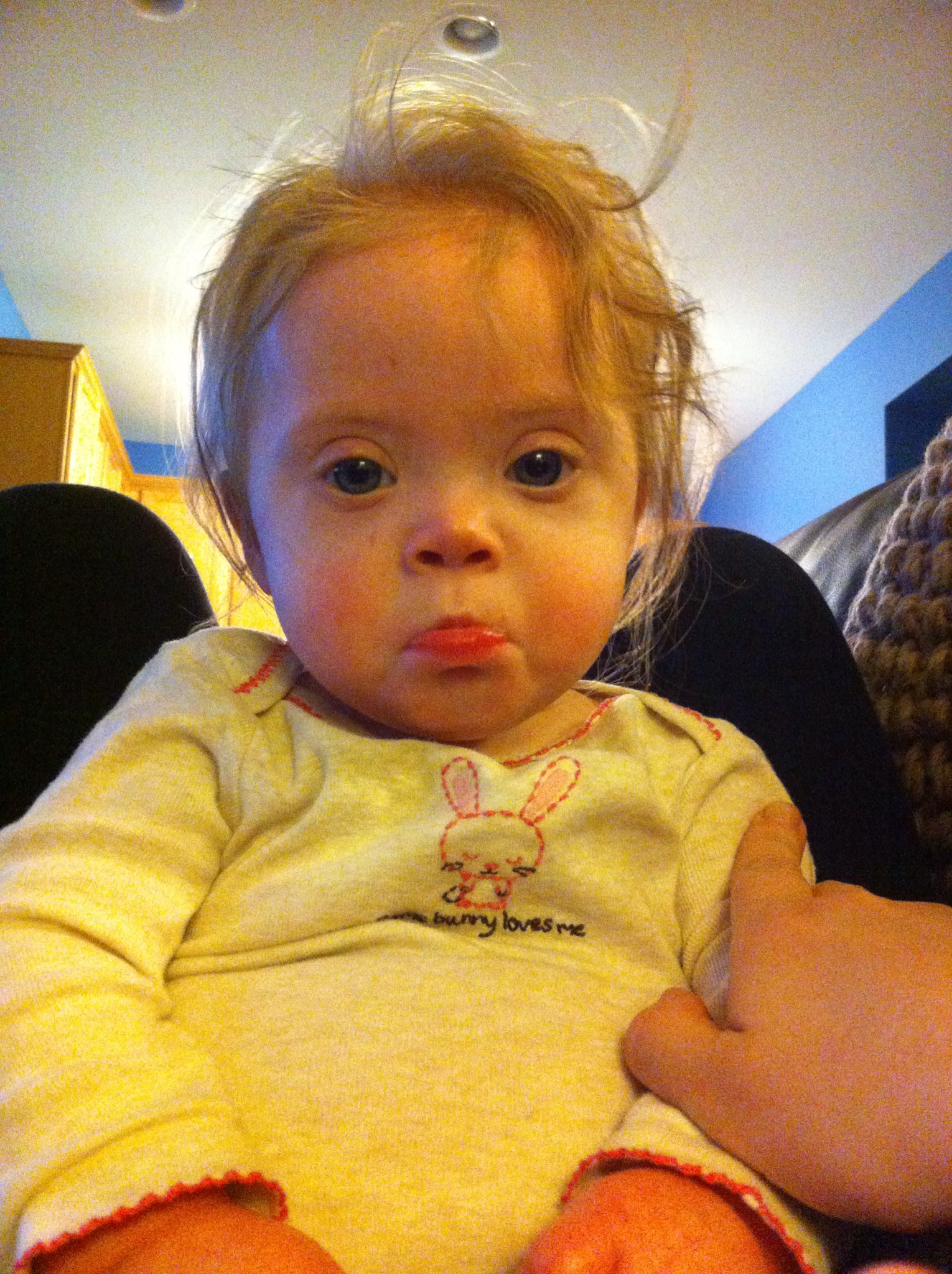
You may not remember my family, but I am writing today to thank you for an experience that we had with you that I will never forget. In December of 2013, my daughter, Tessa, was born at your hospital. You might remember her looking like this:

Her birth happened very quickly and as I vaguely recall, you were called to the delivery because her heart rate was dropping. Within moments after her delivery, while I was still in the process of delivering the placenta, you told my husband, John, that she had strong markers for Down syndrome. We did not undergo any prenatal testing, so this news completely blindsided us. I was frozen in that moment for a long time.
I will be very honest with you, at first, I was very angry at the way you shared her suspected diagnosis with my family. I felt, at the time, that it could have waited until I was at least done with my labor and had had the opportunity to hold my sweet girl. But with time comes perspective, and I want you to know that the way you shared the news with us was quite possibly the best thing someone has ever done for my family. I have never felt angry or devastated about my daughter’s genetic make-up and while there are many factors that play into my outlook on Tessa’s life, you were certainly key.
You see, I have joined a lot of communities for families with children with Down syndrome since Tessa’s birth and have consistently heard horror stories of (probably) well-meaning doctors delivering a diagnosis like a death sentence. However, the way that you treated her extra chromosome… as a passing fact rather than a defining characteristic… set a precedent for the way we have approached Tessa and her life. She is our daughter, a person first, more alike than different.
Tessa is nine months old now. She is happy-go-lucky, quick with a smile, laid-back, and is totally thriving. Her older sister absolutely adores her. She is the favorite “toy” in her daycare. We were in tears when we got to experience her first giggles. She is almost crawling on all fours. My whole family is smitten with Tessa. She has truly changed our life in the most amazing way.
The team at CDH who took care of us during Tessa’s time in the NICU was absolutely stellar and we recommend everyone we know to this hospital. In the spring, when Tessa was admitted to a different hospital in respiratory distress (she had pneumonia), we insisted on being transferred to CDH once she was stable because we knew that the care our family would receive is unmatched. I sincerely thank you for not defining my daughter by her diagnosis and for not giving us a single reason to feel sorry for our beautiful little girl.
Most sincerely,
John, Maggie, Ellie, and Tessa
PS: For other resources for delivering a Down syndrome diagnosis, I highly recommend the Down Syndrome Diagnosis Network. They have great resources for physicians and familes alike: http://www.dsdiagnosisnetwork.org/
This is part of the 31 for 21 Blog Challenge. And it’s probably a little boring unless you know nothing about Down syndrome. 🙂
Lesson #2 was supposed to be Lesson #1. We all know how that worked out. Moving on.
The first lesson that we learned about Down syndrome when Tessa was born is what, exactly, Down syndrome is. We received no less than four copies of the book Babies with Down Syndrome within the first week of Tessa’s life. When she joined our family, I could flash back to freshman biology and picture neat little lines of chromosomes in my textbook coupled with the sweet little face of a child with Down syndrome. However, that’s where the knowledge mostly stopped. The books were welcome treasure chests of information about our baby. Not everything inside was gold; some of the contents scared us or overwhelmed us, but it was a glimpse into where we were headed.

There are three kinds of Down syndrome: Nondisjunction (Trisomy 21), translocation, and mosaicism. Tessa’s type, nondisjunction, accounts for 95% of cases. It occurs equally across all races, genders, and socio-economic levels. While it has a higher occurrence rate in older moms, 80% of babies born with Down syndrome have moms that are under the age of 35. For a cute biology lesson on how it occurs, check out this video:
Trisomies (three copies of a chromosome) happen on other chromosomes as well. However, many other trisomies (but not all) end in miscarriage or are fatal soon after birth. The theory with Down syndrome is that because the chromosome is so short (and contains less genes), people can be born with Ds and live.
This link will take you to some very detailed information about which genes are on chromosome 21. It’s a lot of science mumbo-jumbo, but it sort of explains some of the common issues that we see with Down syndrome. Some of the genes on chromosome 21 affect cells related to muscle tone, eye sight, hearing, the heart, and blood. So, in Down syndrome, we see higher instances of low muscle tone, poor eyesight, hearing difficulty/loss, heart defects, and some types of leukemia.
Low muscle tone (hypotonia) has been the biggest challenge for Tessa to overcome at this point. It doesn’t mean that she is weak (weight lifting doesn’t really help in this case 🙂 ), it means that at rest, her muscles are more lax that would be considered normal and it takes her more energy to make them move than it would you or I. While it obviously affects her motor development, it’s easy to forget that there are other muscles that are affected. Stomach muscles, eye muscles, muscles used to swallow… they are all affected. The opposite of low muscle tone is manifested in conditions like cerebral palsy.
It’s important to remember that someone with Down syndrome has 46 normal chromosomes and one extra. So while Tessa certainly looks like she has Down syndrome, she also looks a lot like I did as a baby. It’s also important to know that there are not “shades” of Down syndrome; there are no severe or mild cases. You either have it or you don’t.
While I, personally, am not easily offended by most things, it’s important to learn how to best talk about Down syndrome within the community. In the United States, the condition is called “Down syndrome.” You refer to someone as a person, and if you need to reference the Ds, it is proper to say “a person with Down syndrome.” It’s not considered appropriate to use the phrase “Downs baby” or “Down syndrome girl.” In the Down syndrome community, it’s important to use people-first language. We don’t appreciate the comment that our children “suffer from Down syndrome” or the notion that they afflicted with it. It can be hurtful to some people to say things like “she barely seems to have anything wrong with her” or “you can hardly tell.” We’re mostly a positive group and truly appreciate if you focus on our kids simply as kids, not as a diagnosis.
For more information on Down syndrome and people-first language, check out the National Down Syndrome Society’s website.
I thought a lot about how I wanted to start my Blog 31 for 21 Challenge. I have a list, you know. Of course I do.
Instead of my awesome blog start, I got work, work, double work, paperwork, pick up kids, migraine starts, football game, potty break in locker room, drive through dinner, beer. Pajamas, prayers, teeth brushed, stories read, lights out, Extra Strength Tylenol, crash on couch, Peppermint Patty.
I think it lends itself well to one of my first lessons after Tessa’s birth: life isn’t going to stop just because of this diagnosis. Sure, we cram in a few therapy sessions, sometimes we get sidetracked by an illness or a doctor’s visit, and Lord knows, we are on a different pace than we may have planned, but the world has not stopped turning because of Down syndrome.
We take the kids to restaurants and ice cream parlors. We throw them into the car for road trips and family functions. We still work, they go to daycare. We have our parties and bonfires and go out on dates without them so that we can complain about how crazy they make us and how much we miss them when they aren’t around. They have sleepovers at Mimi’s house and we go to church when we can and all of the things that have always happened still happen.
Life doesn’t have to stop when Down syndrome enters. It may adjust, but it still marches on and we can make of it whatever we choose.

Tonight, we’re gearing up for October. 🙂 Throughout the next month, I am participating in the 8th Annual 31 for 21 Blog Challenge. It is a call for bloggers (like me!) to write every day in October to promote Down syndrome awareness. 31 days in October and Down syndrome is 3 copies of the 21st chromosome… make sense?? Each day in October, I plan to share something that I have learned since Tessa was born nine months ago. I hope you’ll continue to join us on our journey.
Happy Down Syndrome Awareness Month!
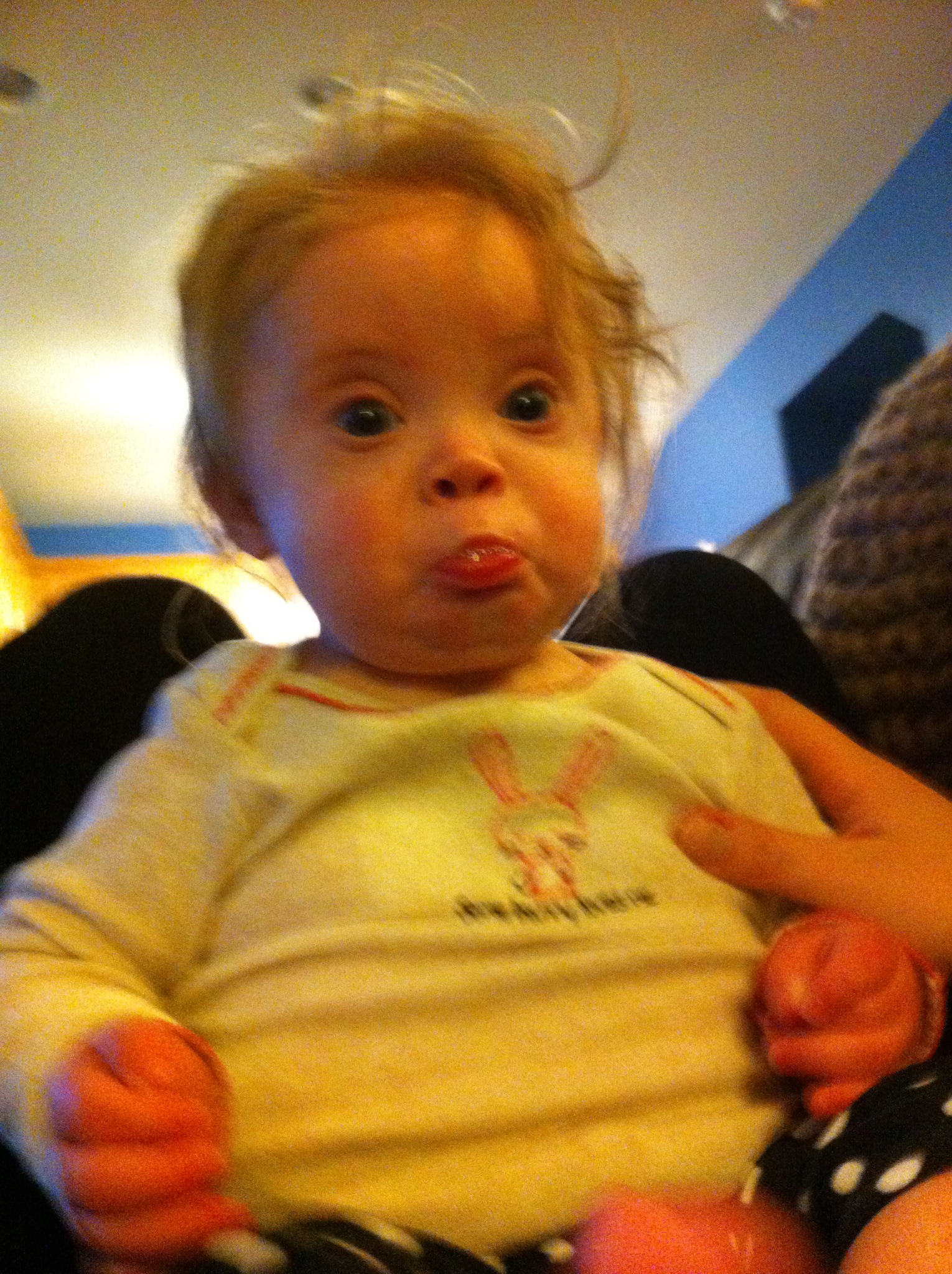
Well, the car seat carrier is getting heavy. I’m not sure how much longer I will be able to cart my sack of potatoes around in it without enrolling in a gym to build up some muscles. One of my most favorite things about Tessa is the fact that she literally melts into your shoulder when you hold her. It’s a product of her low muscle tone (meaning: it takes her more energy to get the muscles going than is typical) and I adore it. However, when it comes to her being carried in a car seat or otherwise, she gets heavy fast. With little to no assistance from her own muscles, mine are tired.
I bring this up only because we had a nine-month visit with Tessa’s pediatrician today and she is tipping the scales 😉 at almost 17 pounds and 26 inches these days. She’s essentially not on the growth charts for height or head circumference, though not surprisingly, her weight was on the percentile charts. On the old, no-longer-in-use Down syndrome growth charts, she’s at a solid 50th percentile in all areas and continues to grow. And, as John so correctly noted, she’s in the 100th percentile for cuteness. For comparison’s sake, she’s about the size that Ellie was at 5 months.
(Yes, I did run home and check Ellie’s baby book for that comparison. But, for the record, I was only trying to determine how much longer I might be able to keep Tessa in the six month clothes, based on what Ellie was wearing. I think we’ll get through the fall and maybe part of the winter…. yippee!)
With good reports from cardiology, her ENT, and her eye doctor, we are thankful to have a little break from appointments until the end of the year. We don’t have to go back to cardiology until she is about 2 and a half. They are still monitoring the very, very small hole that Tessa has between the top two chambers of her heart. It is causing no issues and we fully expect that the hole will close on its own in the next couple of years. If not, she may have surgery at around 3-5 years of age. No ear infections recently, tubes are still in, eyesight is normal, clogged tear duct resolved months ago… we’re in good shape! For once, when the doctor asked for any changes to her medical history, I had nothing to add!! Tessa did get her flu shot today as well and took it like a total champ. She puffed out her lower lip a bit, but there was no horrific, blood-curdling scream as her sister tends to do. We had originally thought that Tessa might be our drama queen, but I have to tell ya, she is not showing any signs of being dramatic at this time. Let’s keep it going.
I’ve been oddly reflective over the past couple of weeks, but am saving my posts up for the 31 for 21 Blog Challenge that I will take part in during the month of October (which happens to be Down Syndrome Awareness Month). More details coming soon…. And since my crazy schedule is keeping me from taking a tremendous number of pictures these days, I leave you only with Tessa’s new sleeping position… and solid evidence as to why I pick out the girls’ clothes every day (not John):


At least they are just pajamas, but poor Tessa… 🙂
Ok, so not a yard… more like six inches… but still. I’m not going to take two minutes of your time to talk your ear off today. Instead, I’m going to share two minutes of Tessa that literally has me floating right now.
If you’ve been following Tessa for quite some time… or if you read my post about my defective child, what happens at 1:47 might just get you, too. I watched the video about 4 times before I saw it…
To set this up, we’ve been struggling a bit to find things that motivate Tessa to move. Today, I set up my iPhone camera to record her looking at herself. This is what we got:
I did something really dumb.
Well, not really that dumb, I guess. That’s kind of melodramatic. But still.
Last week, I was invited to talk to our Child Development classes about Tessa and her Down syndrome. They were starting a unit on birth defects (which isn’t how I, personally, would categorize her extra chromosome, but whatever) and the teacher thought I could provide an interesting perspective.
I was totally thrilled to do it. I feel really excited to share my girls with people. I think it helps to make Down syndrome less odd for those who don’t have contact with it. Anything we can do to stop making Ds so stigmatized, I’m on board. And then I got kind of gung-ho about the whole thing and made a PowerPoint with pictures and diagrams. At the last minute, I decided that I would include a video of Ellie at nine months and Tessa now (almost nine months) to show the difference. That’s kind of where I got myself in trouble.
We are making SO MUCH progress with little Miss Tessa! Listen to her talk:
Forgive the awkward camera angles, please. She won’t talk if she knows the camera is on her.
And here, she’s getting a little early-morning ab workout:
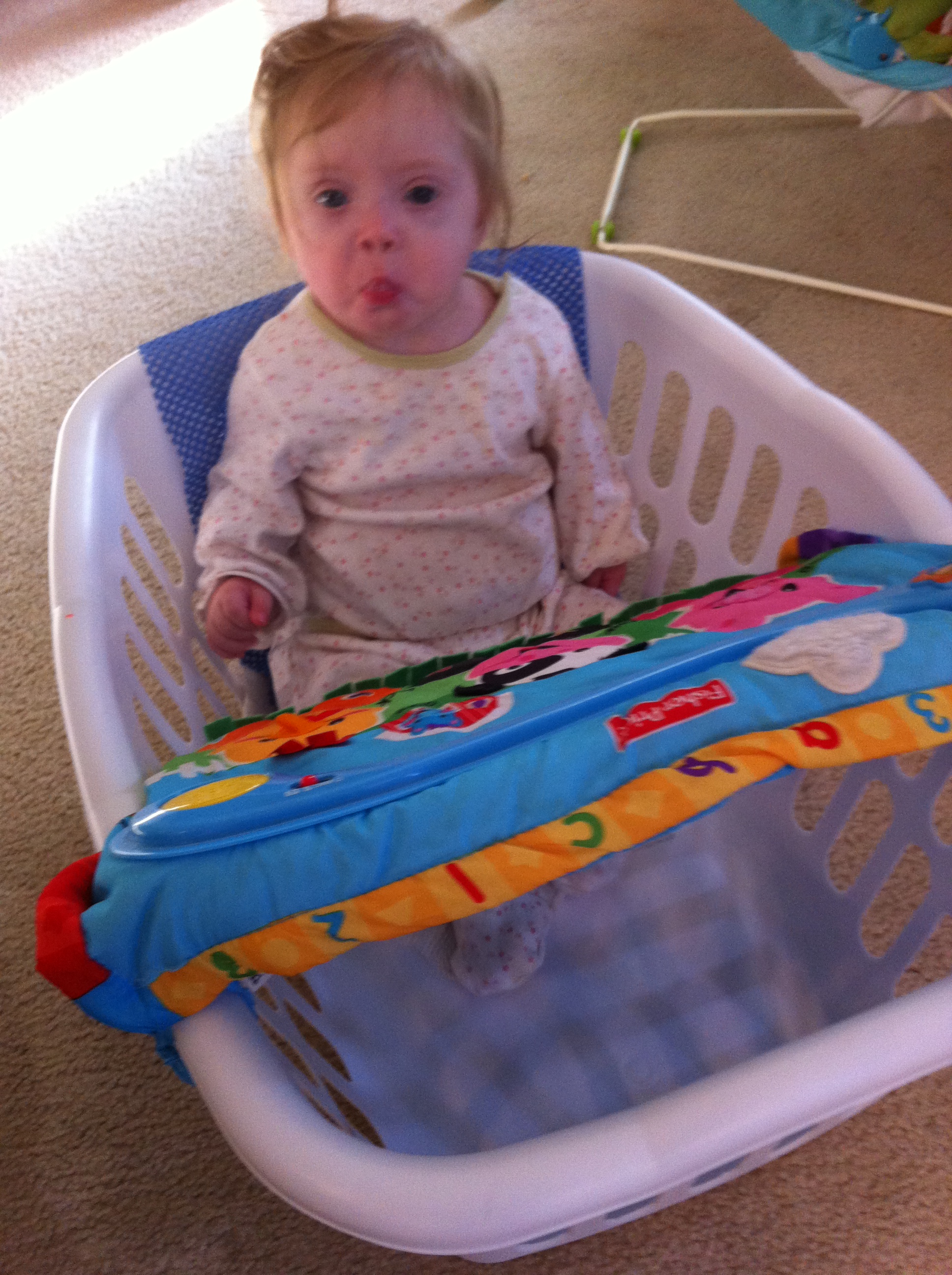
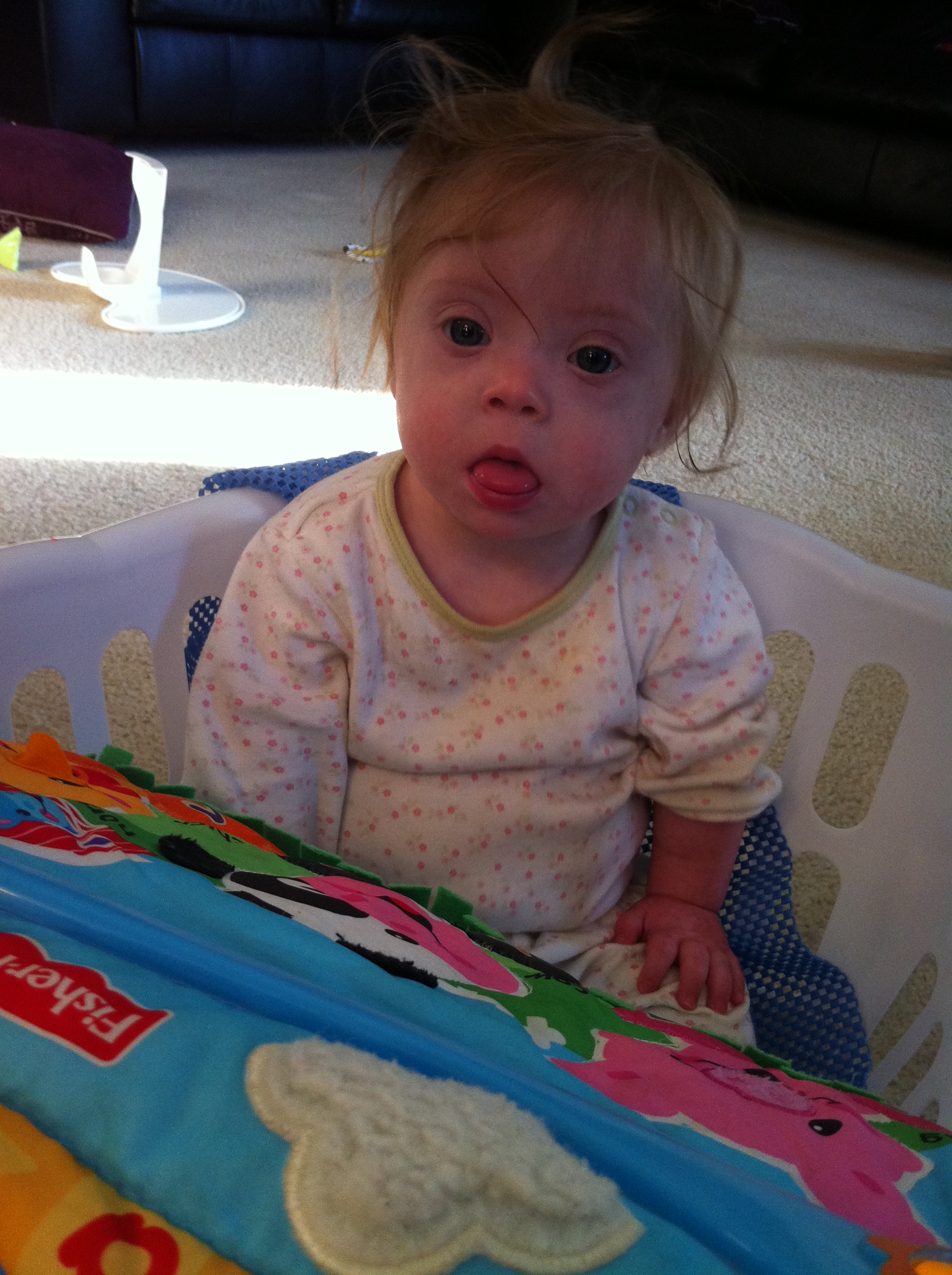

She’s so close to sitting and she’s pulling up into a crawling-like position and she’s eating like a champ. I didn’t need the video reminder of her delays, but there is was. Ellie, so so so cute at nine months, clapping, sitting, babbling. I got a little teary. (For the record, I’m really not a crier.) I’m not sure if it was seeing my threenager so cute and cuddly and small or seeing the progress that Tessa still has to make, but I can tell you that those videos did not make it into the PowerPoint.
Someday, I’ll be really ready to love and embrace watching all my old videos of Ellie. I’m just delayed in that area right now.
The presentation, as a whole, was actually pretty good and very well received. I let them ask me questions about Tessa and got some good ones. The vast majority of them were very concerned about how she will wear glasses if she needs them (since she has no nasal bridge) and wondered if she could wear contacts. They asked how it felt to get the diagnosis (that’s complex), wondered if I wanted more kids (yes), asked if she could do things like drive and live on her own (probably), and were very respectful. One girl asked about why we didn’t do any prenatal tests (that was an awkward thing to explain…carefully… in a public school).
I’m so glad that I went to talk to these kids! I had the opportunity to tell them about how she is actually much more alike than different and that is what really matters. One student asked me how my day-to-day is different with Tessa than it was with Ellie. And I was happy to report that, besides the therapy, it isn’t.
Today I took Tessa to the doctor. She has a cold and since her last cold put her in the hospital for a week, we are being more vigilant.
Yay, copays! :p
In any case, the doctor we saw was new to the practice, so I had the joy of filling her in on Tessa’s medical history. As we got to the end of the appointment, she said to me, “So, you must be in the medical field. What do you do?”
I wasn’t quite sure how she came to that conclusion. What I do is virtually the exact opposite of medicine. Do schools make people healthy?? No, no, no. Schools breed yucky little diseases and keep these doctors working! I just laughed and responded that I’m actually a teacher, then asked how she got that idea.
“Wow,” she said, “you use medical terminology very well!”
Umm, yes. I suppose that at this point, the jargon is more natural to me than the average Joe Schmoe on the street. I feel a little irked, but also a little proud, that she was impressed by my vocabulary. I don’t necessarily want any opportunities to improve it, but at least I know that if I’m ever at a cocktail party with some doctors, I can blend right in.
Who am I kidding? Me? At a cocktail party?? Not unless they are serving margaritas and Bud Light…


 Yo soy La Lay