Yo soy La Lay

adventures in family, faith, and Down syndrome

Lesson #24: She’s just another leaf

I have had very few negative thoughts regarding Down syndrome.  But I’ll let you in on a little secret: for several hours after she joined our family, I was terrified about family pictures.  Somehow, in my brain, I had decided that family and friends would no longer want to take pictures with us because they would not want to have a picture of Tessa hanging on their living room wall.

This is, without a doubt, the most ridiculous thought that I have ever had, bar none.

(Except for maybe the night in college that I thought a bottle of Jack Daniels and some Dixie Cups would make for a good night.  But that’s a whole other story.)

Since she arrived, Tessa has been just another leaf on the family tree.  She’s different, but we all are.  And not one person in our family has taken her as anything less than that.

Being a part of the community of families with children with Down syndrome, I hear a lot of stories.  Most are positive.  Sometimes, however, a mom comes looking for advice on how to deal with family/friends who are struggling to accept her child.  There are families who refuse to acknowledge the baby, or who won’t hold it, or those who treat the child differently through words and actions.  My heart really aches for those families.  It also overflows with love and gratitude for my own.

(Just to clarify – when I say “my family,” I am talking about the whole dang thing, from both John’s side and mine.)

When Tessa was born, I did a really poor job of allowing other people to process our new situation in their own way.  No grieving was allowed on my watch.  Whether I should have let go of that control is a question for a different day, but in reality, I don’t think anyone would have grieved anyway.  Because this is how life really is:

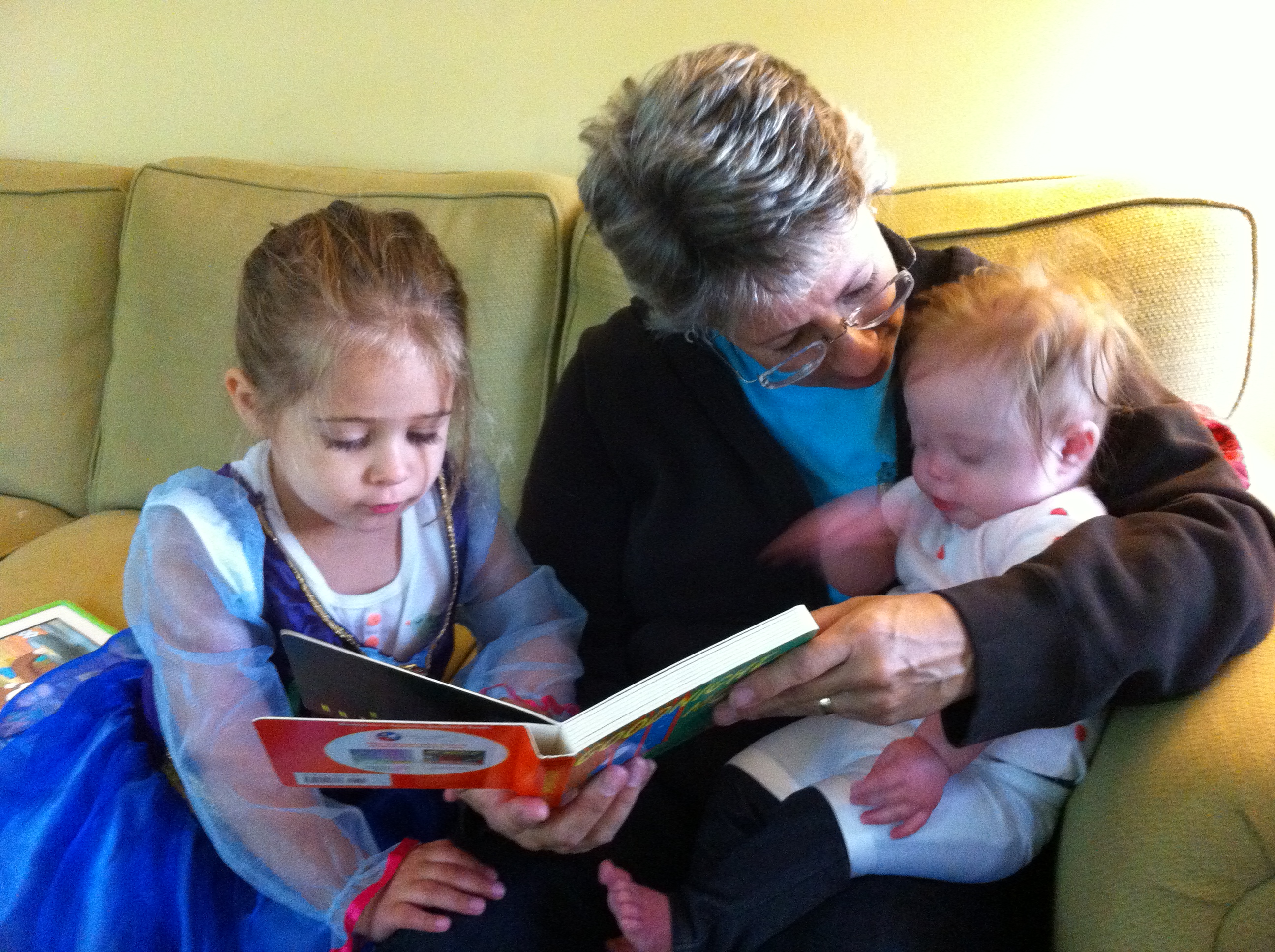
Tessa has four doting grandparents, who love her fiercely and in completely different ways.  They are teachers, snugglers, cheerleaders, and many times, the glue that keeps John and I running smoothly when life is exceptionally busy.

She has aunts and uncles who hold her and play with her as they would any other child.  She adores them.  If there is one thing that we have learned about Tessa’s personality, it’s that once she has attached herself to you, her eyes will look so deep into your eyes that you’ll swear she’s looking right at your soul.  All of her aunts and uncles get those looks.

Tessa’s cousins make her giggle. They poke and prod her, motivating her to get moving.  They give her kisses and pull her hair and sit on her and take her toys just like they would with any other child.

I could not ask for more.

(this pic was taken by my fabulous cousin, Jessica.  It’s blurry now for lots of reasons. 😉 )wdowiarz pic

IMG_4575

photo (17)

IMG_5582

IMG_5837

IMG_4515

3 Comments »

Lesson #21: Unintentional Ableism

Ableism – a set of practices and beliefs that assign inferior value (worth) to people who have developmental, emotional, physical or psychiatric disabilities.

We would love to see Tessa break down barriers, exceed expectations, go beyond anyone’s wildest predictions of what she will accomplish in her lifetime.  John and I have no preconceived notions for what she will do with her life. Full inclusion through high school?  Why not?  Go to college?  OK!  Open a restaurant like Tim’s Place?  Dandy!  Star in a TV show like Glee?  Great!  We set no limits on her potential and watch to see what happens.  Hopefully, that is a powerful force in her life that pushes her to do her best.

She might not do any of those things.

The reality of our future with Tessa (and with any child, really) is that we have no way to predict what will come as she grows.  It is certainly our responsibility, as parents, to teach our children to live to their full potential.  However, we cannot pass judgement on what that potential is.

There is still value in the life of an adult who bags groceries at the local supermarket.

There is still value in the life of an adult who lives with his parents and takes public transportation to a minimum-wage job.

There is still value in the life of an adult who “makes your french fries.”

(On a side note, I just need to vent for one second about the statement “well, someone has to make my fries.” There is nothing wrong with making french fries.  And yes, someone really does have to make them for you unless you plan on climbing into the drive-thru window at McDonald’s and making them yourself.  So why do we need to use this as a sarcastic comment to mock a person’s intellectual ability?  Just wondering.)

Being successful has nothing to do with money.  It has nothing to do with power.  It has nothing to do with influence or intelligence or ability or stuff.  It has everything to do with abounding love, kindness to the most unkind people, friendship, compassion, and contributing in the best way that one can.

I get that now.

Truth.

This is part of the 31 for 21 Blog Challenge!

4 Comments »

Lesson #19: Occupational Therapy: No occupation required

The most recent addition to Tessa’s therapy regimen is Occupational Therapy (OT). Around six months, we noticed that Tessa wasn’t really engaging her hands. In fact, she spent most of her time with her hands balled up tightly in fists. There was very little reaching for objects and if she actually got hold of something, it was released almost immediately. At her IFSP review, we all agreed that it was time to add weekly OT.

OT focuses more on the fine motor skills required to function. Since starting with Kate, Tessa’s therapist, we have seen great strides in her ability to use her hands. She will reach for toys and play with them. She plays with her toes. When on her belly, she will use her arms to push up. Most of the time when she does that, she has her hands open.

We are still fighting with her left hand. She has a tendency to keep a couple of her fingers curled up when she’s pushing up onto hands and knees. She grabs more frequently with her right, using her left to stabilize her body. In therapy, we work a lot with engaging the left. Her issues are small, but on the radar.

OT is one of the therapies that Tessa gets at daycare, so I don’t have a lot of info about what a session might look like. However, Kate sends me detailed notes so that I can see how she did. Right now, just like in PT, we are working on sitting and playing with objects. We have to get Tessa to build strength in her core so that she can stop counting on her hands for stabilization. Kate puts her in a lot of different positions (belly, knees/hands, sitting, etc) and then uses different toys to motivate Tessa to reach for them. We’re also working on getting Tessa to hold her own bottle.

OT, PT, and Speech are once a week for an hour. The last therapy, saved for tomorrow, is Developmental Therapy. More on that tomorrow!

Sitting at 6 months (see the hands?!)

IMG_5822.JPG

Sitting now… Progress! (Also, the only happy Bears fan in the USA today)

IMG_6490.JPG

1 Comment »

Lesson #18: Little babies can do Speech therapy!

This is part of the 31 for 21 Blog Challenge!

So, first of all, this happened:

photo 1 (6)Ellie was enthralled with her potty costume… Once her cousin Jimmy came over dressed as Curious George, it was over.  Somehow, Ellie convinced him to shed his costume so that she could wear it and then the two of them had a grand ol’ time pretending to use the potty.  Kids are weird.

A rough transition here…. on to Speech.

It was very perplexing to me that we could start Speech therapy on a 6-week-old baby.  However, with Tessa unable to take her bottle in an upright position, we were set up with a type of Speech therapist who specializes in Oral-Motor therapy.  Oral-Motor therapy teaches a child awareness, coordination, and strength of the muscles of the mouth (all related to that low muscle tone that we keep talking about).

(On a side note, because I know some are curious, no, my children have not really been nursed.  Ellie got 5 days and Tessa got 12.  That’s a whole other story.)

During a therapy session, we work a lot on building strength in her core muscles.  When you think about eating, you use muscles throughout your abdomen, neck, and head to eat effectively.  One of the ways that we can improve Tessa’s eating skills is to build strength throughout her body so that she will be stable when she is sitting and can begin to use her hands to move food to her mouth.  This part of the session focuses on sitting and bringing toys to the mouth.

We also work on direct input to the mouth itself.  We started by providing input with a tool like this:

We use it to teach her tongue and gums what different textures and pressures feel like.  We also work on stimulating her tongue to move around the mouth to react to food.  Lately, we have graduated to putting small crumbs of graham cracker or animal cracker on the sides of her mouth so that she learns to move the food and to swallow it.

We always end our session with feeding.  Well, I shouldn’t say always.  Sometimes, Tessa gets really mad when she doesn’t get fed first.  And sometimes, she decides that she has had enough and just closes her eyes and goes to sleep.  However, we like to do some “spoon work” with the therapist when Tessa will let us.  🙂  We have found that a forward-facing presentation of the spoon (how you or I would put a spoon in our mouth) is challenging for her, so we present the spoon sideways.  However, we also continue to work on the forward presentation.  We are teaching her to get the food off the spoon and swallow.  She also has a habit of sticking her tongue out while she eats, so we have to wait until she puts her tongue in the right place before allowing her to take a bite.  Remember that a tongue is made up of a lot of different muscles, so her low muscle tone affects her ability to keep it in the appropriate place and use it effectively.

Our next steps with Tessa are to introduce a straw cup (recommended over a sippy cup) and to slowly increase the variety of textures that she will tolerate. We have begun to work on the actual “speech” part of Speech therapy with practice mimicking noises,  We have introduced signs for more, all done, eat, and drink.

The most important thing to remember is that while we have made modifications for Tessa and we do have to make a conscious effort to teach her some skills that may come naturally to others, our life is not work.  We don’t live in a constant therapy session, always practicing, practicing, practicing.  When we can, we do these things.  That is all.  There are weeks when we do a lot of practice.  Sometimes, we don’t.  Eventually, we’ll get there.

An excellent resource that I have just started to dive into is Early Communication Skills for Children with Down Syndrome.  Click on the blue link to find it on Amazon.

Blurry, but perfect…

photo (15)

3 Comments »

Lesson #11: Daycare is just the right thing to do (for us)

This is part of the 31 for 21 blog challenge!

There was never a doubt in my mind that I would be a working mom. Some girls imagine themselves taking care of babies and running their households. That was never me. I do all of that stuff, but I also have a job that I love and my kids go to Miss Julie’s house for their daytime care.

I’ll tell you more about Julie when I have a keyboard and I can do her justice. For now, suffice it to say that she has been a true blessing for our family. My girls adore her and her house.

What I love about daycare for Tessa is that she is totally thriving surrounded by older, typical kids. While playing with her sister gives her some exposure to words, movement, big-kid stuff, play at daycare is even more busy and complex. It has been her normal life routine for so long, since she was just three months old. It’s good for her. Case in point:

IMG_6432.PNG

Julie sent me that picture yesterday. It looks boring enough, just four kids hanging out around the box of Frozen toys. But the amazing background story is that Ellie and the other two were playing excitedly with these toys and Tessa army-crawled her way across the room to see what they were playing with. Motivation. Example. Acceptance.

She is in the right place.

1 Comment »

Lesson #4: Being a “Magnet Family” is Not So Bad

This is part of the 31 for 21 Blog Challenge!

I will confess to you that I truly despise those little stick figure families that people stick on the back of their minivans. I have always been intrigued by bumper stickers, but in general have just found them silly. Why does anyone really need to express to the world their love and support for their favorite dog/politician/radio station/eating preference/moral belief? I really never understood it.

(My favorite was the time I saw an older man driving a car with SEVEN variations of a “breast is best” sticker.)

I’m sure that part of all of this is my father in me. For whatever reason, it has stuck with me that he never put stickers on any of our cars. I’m sure that when I was 16, I probably wanted some Backstreet Boys logo to be plastered on the back of our little white Buick Skylark and he told me no. But I digress…

This is all at the forefront now because one of our favorite parent groups, UPS for DownS, gave us a car magnet. It took me several days to feel like I could put the darn thing on my car. One of the balancing acts that we walk as parents with kids with special needs is the strong desire to accepted as a “normal” family, while still needing the support network of those people who are different like us. And so there is a small fear of branding ourselves as “that family who has a kid with Down syndrome” rather than just being “the Lays.”

I’m fairly positive that no one in our circle of family and friends gives any thought at all to our differences. If they do, they don’t show any sign of it.

In any case, the magnet is there now, in the hopes that another family who might need to get connected will reach out. Or so that some passerby in the Meijer parking lot will notice and understand that we are really not unusual. It’s been there for a couple weeks and it just kind of blends in. I would probably never even notice it if Ellie didn’t hide it in strange places all the time.

It’s just a silly little magnet that sort of sets us apart. There’s no reason for it to be a big deal and somehow, it is. And yet, somehow, it isn’t at all.

Leave a comment »

Lesson #2: What Down Syndrome IS (and how to talk about)

This is part of the 31 for 21 Blog Challenge.  And it’s probably a little boring unless you know nothing about Down syndrome.  🙂

Lesson #2 was supposed to be Lesson #1.  We all know how that worked out.  Moving on.

The first lesson that we learned about Down syndrome when Tessa was born is what, exactly, Down syndrome is.  We received no less than four copies of the book Babies with Down Syndrome within the first week of Tessa’s life.  When she joined our family, I could flash back to freshman biology and picture neat little lines of chromosomes in my textbook coupled with the sweet little face of a child with Down syndrome.  However, that’s where the knowledge mostly stopped.  The books were welcome treasure chests of information about our baby.  Not everything inside was gold; some of the contents scared us or overwhelmed us, but it was a glimpse into where we were headed.

There are three kinds of Down syndrome: Nondisjunction (Trisomy 21), translocation, and mosaicism.  Tessa’s type, nondisjunction, accounts for 95% of cases.  It occurs equally across all races, genders, and socio-economic levels.  While it has a higher occurrence rate in older moms, 80% of babies born with Down syndrome have moms that are under the age of 35.  For a cute biology lesson on how it occurs, check out this video:

Trisomies (three copies of a chromosome) happen on other chromosomes as well.  However, many other trisomies (but not all) end in miscarriage or are fatal soon after birth.  The theory with Down syndrome is that because the chromosome is so short (and contains less genes), people can be born with Ds and live.

This link will take you to some very detailed information about which genes are on chromosome 21.  It’s a lot of science mumbo-jumbo, but it sort of explains some of the common issues that we see with Down syndrome.  Some of the genes on chromosome 21 affect cells related to muscle tone, eye sight, hearing, the heart, and blood.  So, in Down syndrome, we see higher instances of low muscle tone, poor eyesight, hearing difficulty/loss, heart defects, and some types of leukemia.

Low muscle tone (hypotonia) has been the biggest challenge for Tessa to overcome at this point.  It doesn’t mean that she is weak (weight lifting doesn’t really help in this case 🙂 ), it means that at rest, her muscles are more lax that would be considered normal and it takes her more energy to make them move than it would you or I.  While it obviously affects her motor development, it’s easy to forget that there are other muscles that are affected.  Stomach muscles, eye muscles, muscles used to swallow… they are all affected.  The opposite of low muscle tone is manifested in conditions like cerebral palsy.

It’s important to remember that someone with Down syndrome has 46 normal chromosomes and one extra.  So while Tessa certainly looks like she has Down syndrome, she also looks a lot like I did as a baby.  It’s also important to know that there are not “shades” of Down syndrome; there are no severe or mild cases.  You either have it or you don’t.

While I, personally, am not easily offended by most things, it’s important to learn how to best talk about Down syndrome within the community.  In the United States, the condition is called “Down syndrome.”  You refer to someone as a person, and if you need to reference the Ds, it is proper to say “a person with Down syndrome.”  It’s not considered appropriate to use the phrase “Downs baby” or “Down syndrome girl.”  In the Down syndrome community, it’s important to use people-first language.  We don’t appreciate the comment that our children “suffer from Down syndrome” or the notion that they afflicted with it.  It can be hurtful to some people to say things like “she barely seems to have anything wrong with her” or “you can hardly tell.”  We’re mostly a positive group and truly appreciate if you focus on our kids simply as kids, not as a diagnosis.

For more information on Down syndrome and people-first language, check out the National Down Syndrome Society’s website.

3 Comments »

Lesson #1: We ain’t slowin’ down.

I thought a lot about how I wanted to start my Blog 31 for 21 Challenge.  I have a list, you know.  Of course I do.

Instead of my awesome blog start, I got work, work, double work, paperwork, pick up kids, migraine starts, football game, potty break in locker room, drive through dinner, beer.  Pajamas, prayers, teeth brushed, stories read, lights out, Extra Strength Tylenol, crash on couch, Peppermint Patty.

I think it lends itself well to one of my first lessons after Tessa’s birth: life isn’t going to stop just because of this diagnosis.  Sure, we cram in a few therapy sessions, sometimes we get sidetracked by an illness or a doctor’s visit, and Lord knows, we are on a different pace than we may have planned, but the world has not stopped turning because of Down syndrome.

We take the kids to restaurants and ice cream parlors.  We throw them into the car for road trips and family functions.  We still work, they go to daycare.  We have our parties and bonfires and go out on dates without them so that we can complain about how crazy they make us and how much we miss them when they aren’t around.  They have sleepovers at Mimi’s house and we go to church when we can and all of the things that have always happened still happen.

Life doesn’t have to stop when Down syndrome enters.  It may adjust, but it still marches on and we can make of it whatever we choose.

Love this!  Belongs in my classroom somewhere....

8 Comments »

Nine Months

Well, the car seat carrier is getting heavy.  I’m not sure how much longer I will be able to cart my sack of potatoes around in it without enrolling in a gym to build up some muscles.  One of my most favorite things about Tessa is the fact that she literally melts into your shoulder when you hold her.  It’s a product of her low muscle tone (meaning: it takes her more energy to get the muscles going than is typical) and I adore it.  However, when it comes to her being carried in a car seat or otherwise, she gets heavy fast.  With little to no assistance from her own muscles, mine are tired.

I bring this up only because we had a nine-month visit with Tessa’s pediatrician today and she is tipping the scales 😉 at almost 17 pounds and 26 inches these days.  She’s essentially not on the growth charts for height or head circumference, though not surprisingly, her weight was on the percentile charts.  On the old, no-longer-in-use Down syndrome growth charts, she’s at a solid 50th percentile in all areas and continues to grow.  And, as John so correctly noted, she’s in the 100th percentile for cuteness.  For comparison’s sake, she’s about the size that Ellie was at 5 months.

(Yes, I did run home and check Ellie’s baby book for that comparison.  But, for the record, I was only trying to determine how much longer I might be able to keep Tessa in the six month clothes, based on what Ellie was wearing.  I think we’ll get through the fall and maybe part of the winter…. yippee!)

With good reports from cardiology, her ENT, and her eye doctor, we are thankful to have a little break from appointments until the end of the year.  We don’t have to go back to cardiology until she is about 2 and a half.  They are still monitoring the very, very small hole that Tessa has between the top two chambers of her heart.  It is causing no issues and we fully expect that the hole will close on its own in the next couple of years.  If not, she may have surgery at around 3-5 years of age.  No ear infections recently, tubes are still in, eyesight is normal, clogged tear duct resolved months ago… we’re in good shape!  For once, when the doctor asked for any changes to her medical history, I had nothing to add!!  Tessa did get her flu shot today as well and took it like a total champ.  She puffed out her lower lip a bit, but there was no horrific, blood-curdling scream as her sister tends to do.  We had originally thought that Tessa might be our drama queen, but I have to tell ya, she is not showing any signs of being dramatic at this time.  Let’s keep it going.

I’ve been oddly reflective over the past couple of weeks, but am saving my posts up for the 31 for 21 Blog Challenge that I will take part in during the month of October (which happens to be Down Syndrome Awareness Month).  More details coming soon…. And since my crazy schedule is keeping me from taking a tremendous number of pictures these days, I leave you only with Tessa’s new sleeping position… and solid evidence as to why I pick out the girls’ clothes every day (not John):

photo (13) photo (14)

At least they are just pajamas, but poor Tessa… 🙂photo (12)

1 Comment »

The longest yard

Ok, so not a yard… more like six inches… but still.  I’m not going to take two minutes of your time to talk your ear off today.  Instead, I’m going to share two minutes of Tessa that literally has me floating right now.

If you’ve been following Tessa for quite some time… or if you read my post about my defective child, what happens at 1:47 might just get you, too.  I watched the video about 4 times before I saw it…

To set this up, we’ve been struggling a bit to find things that motivate Tessa to move.  Today, I set up my iPhone camera to record her looking at herself.  This is what we got:

8 Comments »